

As the world develops green hydrogen for industries from steel to aviation, Uganda is seeking to turn its renewable energy advantage into a new engine for industrial growth
Kampala, Uganda | IAN KATUSIIME | Governments from Europe to Asia are investing billions of dollars in green hydrogen, betting that the fuel could play a pivotal role in decarbonising industries that batteries alone cannot power. From steel mills and fertiliser plants to shipping and aviation, hydrogen is increasingly viewed as a building block of the global clean energy transition.
Uganda hopes to become part of this emerging industry. At the COP27 climate summit in Egypt in 2022, the Ministry of Energy and Mineral Development signed a memorandum of understanding with French energy company Hydrogène de France (HDF) to explore the development of the country’s first large-scale green hydrogen production facilities.
Green hydrogen is produced by using renewable electricity to split water into hydrogen and oxygen, creating a fuel that produces no carbon dioxide emissions when used.
While HDF no longer has projects under development in Uganda, the agreement marked an important first step in Kampala’s ambition to develop a domestic green hydrogen industry.
A bigger milestone came in 2024 when the Ministry of Energy, Industrial Promotion Services (IPS), the infrastructure arm of the Aga Khan Fund for Economic Development, and Norwegian green energy company Westgass Internasjonal signed a joint development agreement.
The $400 million venture is being co-financed through a convertible loan from the Norwegian Investment Fund for Developing Countries (Norfund) and grant funding from the Norwegian Agency for Development Cooperation (Norad).
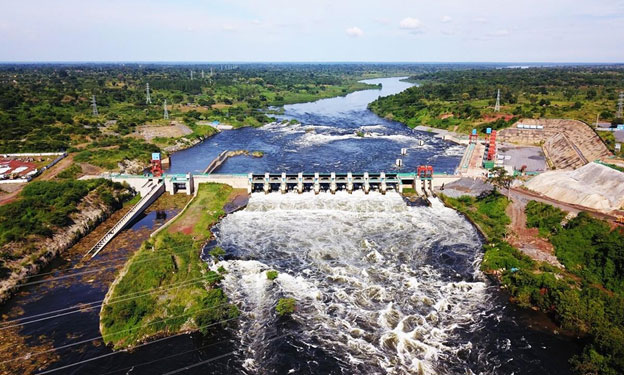
The production facility, located in Karuma, Kiryandongo District, will draw 100 megawatts of clean electricity from the Karuma Hydropower Station to produce green hydrogen through electrolysis.
The facility aims to manufacture 200,000 tonnes of zero-emission mineral fertilisers annually, reducing Uganda’s reliance on costly fossil fuel-based imports.
Energy experts say Uganda’s strong solar and wind potential, combined with its expanding hydropower capacity, could allow it to produce green hydrogen at relatively competitive costs.
“The combination of Uganda’s flexible power supply from hydropower with electrolysers’ potentially flexible demand could play a positive role in absorbing large shares of variable renewable energy from solar and wind over the coming decades,” says Arno van den Bos, an analyst in Green Hydrogen at the IRENA Innovation and Technology Centre in Bonn, Germany, in an email response to The Independent.
IRENA, the International Renewable Energy Agency, is an intergovernmental organisation that supports countries in transitioning towards a sustainable energy future.
“Given the importance of the agricultural sector in Uganda’s economy, it could make sense to prioritise this hydrogen for the production of ammonia fertilisers and therefore reduce Uganda’s imports of hydrogen,” van den Bos says.
Green hydrogen is increasingly viewed as a strategic fuel for decarbonising heavy industry and transport. Across Africa, countries including Uganda are positioning themselves to participate in the emerging global hydrogen economy over the coming decades.
“IRENA generally sees direct electrification as a more efficient way to decarbonise road transport, both passenger and freight, but sees an important role for hydrogen and its derivatives in decarbonising hard-to-abate sectors such as steel, ammonia, chemicals, shipping and aviation,” van den Bos says.
He argues that while East African countries could use their renewable energy resources to decarbonise industry and parts of maritime and aviation transport, other regions may be better positioned to become major global exporters of hydrogen and its derivatives.
“For example, the North African region has equally or sometimes superior renewable resources, and closer proximity to the European market,” he says.
According to IRENA, industries such as aviation, shipping, steel and chemicals account for about a quarter of global energy consumption and produce roughly one-fifth of global carbon dioxide emissions, making them central to the energy transition.
Hydrogen’s global infrastructure
The growing demand for green hydrogen is already reshaping global trade and energy strategies. Governments are not only focusing on producing the fuel but are also investing in the infrastructure required to transport it across continents.
Countries are developing ports, pipelines, transmission networks and shipping corridors that will connect future producers with industrial markets.
One of the clearest examples is the India–Middle East–Europe Economic Corridor (IMEC), unveiled at the G20 summit in New Delhi in 2023.

IMEC is a proposed trade and infrastructure corridor linking India, the Middle East and Europe through rail, ports, energy and digital networks.
Beyond improving connectivity, the project reflects a broader global race to build new supply chains for clean energy, including green hydrogen.
While Uganda is not part of IMEC, the corridor illustrates the scale of the transformation underway. Countries with abundant renewable energy resources are increasingly positioning themselves to supply the clean fuels that future industrial economies will require.
Uganda’s partnership with Westgass Internasjonal represents an early attempt to secure a position in that emerging market.
The development of corridors such as IMEC highlights a larger reality: the future hydrogen economy will depend not only on countries capable of producing clean energy but also on markets with the industrial demand to consume it.
Europe is at the centre of that demand. The European Union has identified green hydrogen as a critical component of its energy transition, particularly for industries such as steel, chemicals, shipping and aviation, where direct electrification remains challenging.
With limited domestic renewable energy resources to meet projected demand, Europe is looking beyond its borders for future hydrogen suppliers.
Uganda’s opportunity
Energy experts say that for countries such as Uganda, the global shift towards green hydrogen presents an opportunity. Unlike fossil fuels, green hydrogen is not extracted from underground reserves; it is produced using renewable electricity.
Countries with abundant hydropower, solar resources and available land could potentially become future suppliers of a commodity expected to play a central role in the global energy transition.
According to the Green Hydrogen Organisation (GH2), a Switzerland-based non-profit that promotes the development of the global green hydrogen economy, Uganda views green hydrogen as a pathway towards industrialisation, investment and future exports.
The organisation says Uganda’s long-term ambition is to leverage its renewable energy resources to participate in the emerging global hydrogen economy by converting clean electricity into a higher-value export commodity while attracting technology, skills and new industries.
Uganda’s investments in renewable energy could strengthen its prospects in this emerging market. Over the past two decades, the country has expanded its electricity generation capacity through hydropower projects such as Karuma, Isimba, Nalubaale and Kiira, while also adding utility-scale solar generation.
Because green hydrogen depends on renewable electricity, these investments provide the foundation for a future hydrogen industry, allowing Uganda to convert clean power into a higher-value industrial and export commodity.
Steel and fertiliser drive demand
One of the biggest drivers of the global hydrogen race is the steel industry, one of the world’s largest sources of carbon emissions.
Traditionally, steel is produced using coking coal to remove oxygen from iron ore, a process that releases significant amounts of carbon dioxide. The International Energy Agency estimates that the iron and steel sector accounts for about 7% of global energy-related carbon dioxide emissions.
Green hydrogen offers a cleaner alternative by replacing coal as the reducing agent, producing water rather than carbon emissions.
As Europe accelerates efforts to decarbonise heavy industry, manufacturers are increasingly investing in hydrogen-based steel production, a shift expected to drive demand for green hydrogen in the coming decades.
According to the International Energy Agency (IEA), hydrogen is also a critical feedstock in the production of ammonia, the building block of nitrogen-based fertilisers that support modern agriculture.
Today, most ammonia is produced using hydrogen derived from natural gas, making the process highly carbon-intensive.
Replacing fossil fuel-based hydrogen with green hydrogen offers one of the fastest ways to reduce emissions from the fertiliser industry while strengthening food security.
For an agricultural country such as Uganda, experts say the technology could eventually support domestic fertiliser production, reduce dependence on imports and create new value chains built around renewable energy.

Aviation, another hard-to-abate sector, is also emerging as a major opportunity for green hydrogen.
Commercial aviation contributes about 2–3% of global carbon dioxide emissions, and unlike passenger vehicles, long-haul aircraft cannot easily rely on batteries because of their weight and limited energy density.
Aircraft manufacturers such as Airbus are investing in hydrogen propulsion technologies, while airports are beginning to explore the infrastructure — including cryogenic storage tanks, specialised refuelling systems and dedicated pipelines — required to support hydrogen-powered aircraft.
Although widespread commercial adoption remains years away, the industry’s investment signals growing expectations that hydrogen will play an important role in decarbonising one of the world’s fastest-growing transport sectors.
Uganda’s renewable energy resources could provide an important foundation for participation in this emerging hydrogen economy.
The country has expanded its electricity generation capacity through investments in hydropower, including projects such as Karuma and Isimba, creating the clean power base required for electrolysis.
Uganda has an electricity surplus of about 2,000 megawatts. The Independent could not obtain comment from the Uganda Electricity Generation Company Limited (UEGCL) on how green hydrogen could provide a commercially viable way of utilising this surplus electricity.
IRENA has identified access to abundant renewable electricity as one of the key advantages for countries seeking to develop green hydrogen industries, particularly in regions with the potential to produce low-cost renewable energy.
However, experts caution that electricity generation alone will not be enough. Turning Uganda’s hydrogen ambitions into a commercial industry will require significant investment in electrolysers, transmission infrastructure, storage facilities and access to reliable markets.
With green hydrogen still more expensive than fossil fuel-based alternatives, the challenge will be proving that Uganda can produce competitively priced hydrogen at a scale attractive to global buyers.
Africa’s hydrogen race
Uganda is entering the green hydrogen race at a time when several African countries are already positioning themselves as future suppliers to global markets.
Namibia, Egypt, Morocco, South Africa and Kenya have moved aggressively to attract investment into hydrogen and green ammonia projects, betting on their renewable energy resources and strategic locations.
Namibia’s flagship Hyphen Hydrogen Energy project, valued at about $10 billion, aims to use the country’s vast solar and wind resources to produce hydrogen for export.
Egypt is leveraging its location along the Suez Canal and proximity to European markets to develop hydrogen and ammonia projects.
Morocco, with its strong renewable energy base and existing industrial links to Europe, and South Africa, with its mining and industrial capacity, are also seeking to establish themselves as regional hydrogen hubs.
Kenya has similarly positioned itself around green ammonia and renewable energy opportunities.
The race for green hydrogen is ultimately a race for industrial relevance.
For countries able to combine renewable energy, infrastructure, technology and investment, hydrogen offers the possibility of moving beyond exporting raw resources and participating in the industries of the future.
Uganda’s renewable energy resources provide an entry point into that emerging market. But turning ambition into reality will require more than agreements and policy commitments.
It will require competitive pricing, reliable infrastructure, long-term buyers and the ability to execute projects at scale.


