

BROOKLYN, N.Y. — When the startup Electra Research launched four years ago, its founders set out to hook more batteries up to the electric grid. Energy storage is key to balancing the coming and going of wind and solar power, and it can help reduce strain on the electricity system during the busiest hours.
But with the line to plug into the grid being very, very long, Electra opted for a faster route: It would put batteries directly in people’s homes, only with a twist. Instead of installing whole-home backup storage, the firm would pair smaller batteries with energy-intensive appliances. The goal was to help people clean up their homes, reduce energy use — and add some useful capacity to the broader electricity system.
“It became clear that the straightforward thing to do is to colocate a battery with the biggest loads in the house, which are water heating, refrigeration, HVAC, and cooking,” Bert Muthalaly, Electra’s CEO, told me from the startup’s new warehouse in Brooklyn.
“And when you look at it that way, there is one that people care about,” he said. “People love their stoves.”
Today, Electra makes battery-powered induction stoves, which it began shipping to U.S. customers in April. The startup recently gave me a first look at its operation on the edge of Brooklyn’s Bushwick neighborhood, where the glass-fronted warehouse sits somewhere between a pickle-packing plant and a kitchen-supply distributor.
When I visited on a cloudy day in late June, Alexia Avina was rewiring a 305-pound appliance to connect a slender battery pack, which fits beneath the drawer that holds broiler trays and pans. Electra does the metalwork for its stoves in China and final assembly at the Brooklyn facility, turning them into energy-storing, Wi-Fi-enabled devices — ones that won’t fill your kitchen with harmful pollution by burning natural gas.
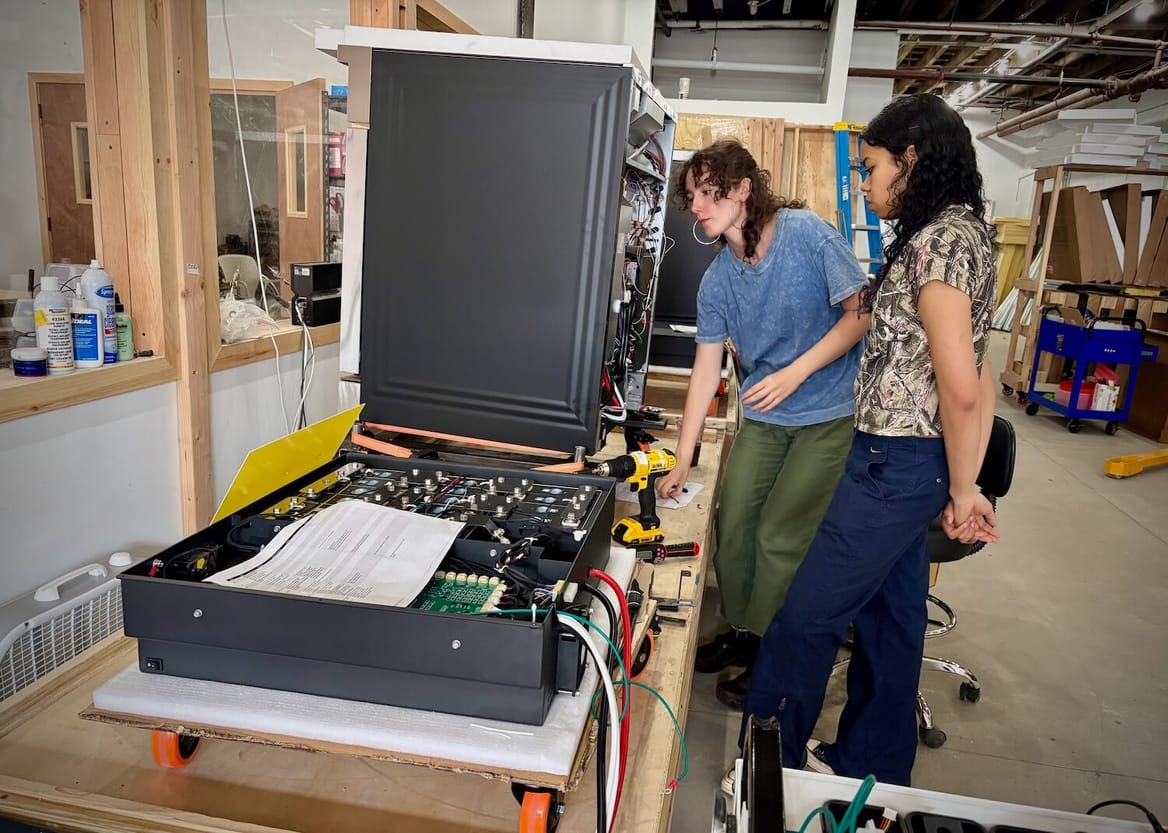
Avina joined the team in May, having mainly worked in restaurants and as a musician before training with Electra’s engineers to outfit the stoves. “It’s been cool to learn something totally different,” she said later while standing next to stacks of stoves packed in cardboard boxes. “It’s rare to have hands-on opportunities like this.”
Unlike many induction stoves on the market, Electra’s model can plug into a standard 120-volt outlet and draw power to charge a 5-kilowatt-hour battery. The induction cooktop heats pans directly using electromagnetism, while the oven cooks food using electric-resistance elements.
Customers can choose to turn their batteries into helpful grid tools. With its software partners, Electra directs the batteries to charge up during the most beneficial times — for example, when solar power production is most abundant — and to discharge power during the grid’s peak demand periods. Electra estimates its appliance uses roughly 80% less peak power than a typical electric-resistance stove.
The company now employs nearly two dozen people, eight of whom work on the Brooklyn production line. It’s self-funded but declined to share financial details.


