The Department of Fertilisers has initiated the process to establish green urea plants in India, outlining a roadmap aimed at advancing sustainable fertiliser production, reducing carbon emissions and supporting the country’s clean energy transition.
According to the department, India currently imports around 10 million tonnes of urea annually, while many existing urea plants are more than 30 years old.
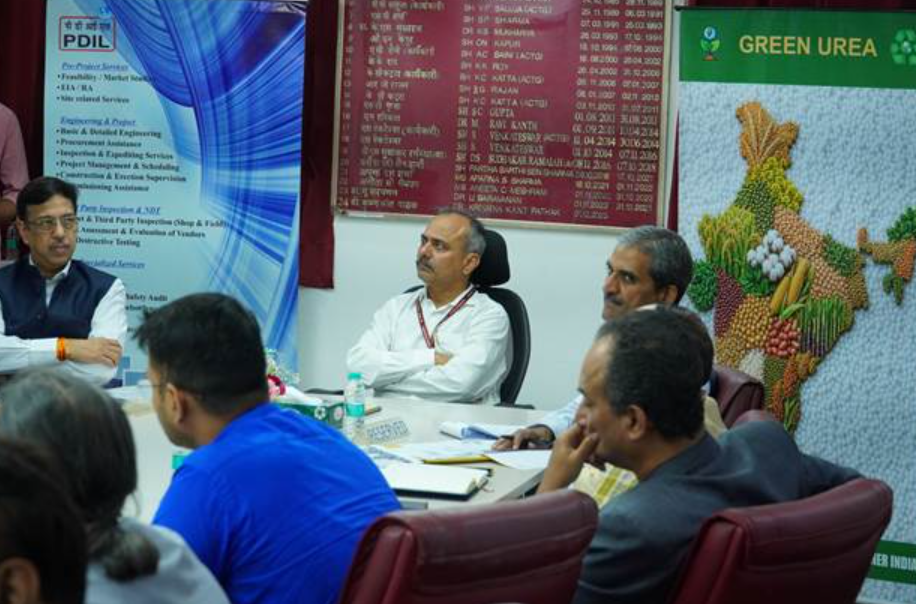
The department held a high-level pre-Expression of Interest (EOI) meeting at Projects & Development India Limited (PDIL) headquarters in Noida, bringing together public and private sector stakeholders, including NTPC, Solar Energy Corporation of India (SECI), fertiliser companies, technology providers and manufacturers of electrolysers, green hydrogen and green ammonia. The meeting followed the issuance of an invitation for Expression of Interest earlier this week for setting up green urea plants across the country.
As part of the roadmap, the Ministry of New and Renewable Energy (MNRE) will provide ₹19,744 crore to strengthen green energy infrastructure, while the Department of Fertilisers will create the institutional and market framework required to integrate green ammonia into domestic fertiliser production.
To address the higher production cost of green ammonia, the government has proposed an offtaker-side differential subsidy mechanism. Under the framework, SECI will procure green ammonia from producers and supply it to fertiliser manufacturers at market-linked grey ammonia prices, with the Department of Fertilisers covering the price difference to ensure cost parity.
The government also plans to procure 7.24 lakh metric tonnes of green ammonia annually under the National Green Hydrogen Mission (NGHM) Mode 2A through a competitive e-reverse auction managed by SECI. Developers will receive incentives for up to 10 years under binding supply agreements, providing long-term market certainty for new greenfield and operational projects.
The roadmap also highlighted the 150 tonnes per day Green Urea pilot plant at Pudimadaka in Andhra Pradesh, developed by NETRA, the research and development arm of NTPC. The facility integrates water electrolysis with carbon capture and utilisation technologies and will serve as a benchmark for future commercial projects.
Captured carbon dioxide from thermal power, cement and steel plants, combined with green hydrogen, could help establish integrated Green Urea projects that strengthen fertiliser security, reduce emissions and support India’s net-zero target by 2070.