

Norway needs hydrogen and ammonia fuel supply chains for longer-distance shipping, even as battery-electric propulsion gains ground in coastal trades, state enterprise Enova said in its 2026 climate and energy transition report.
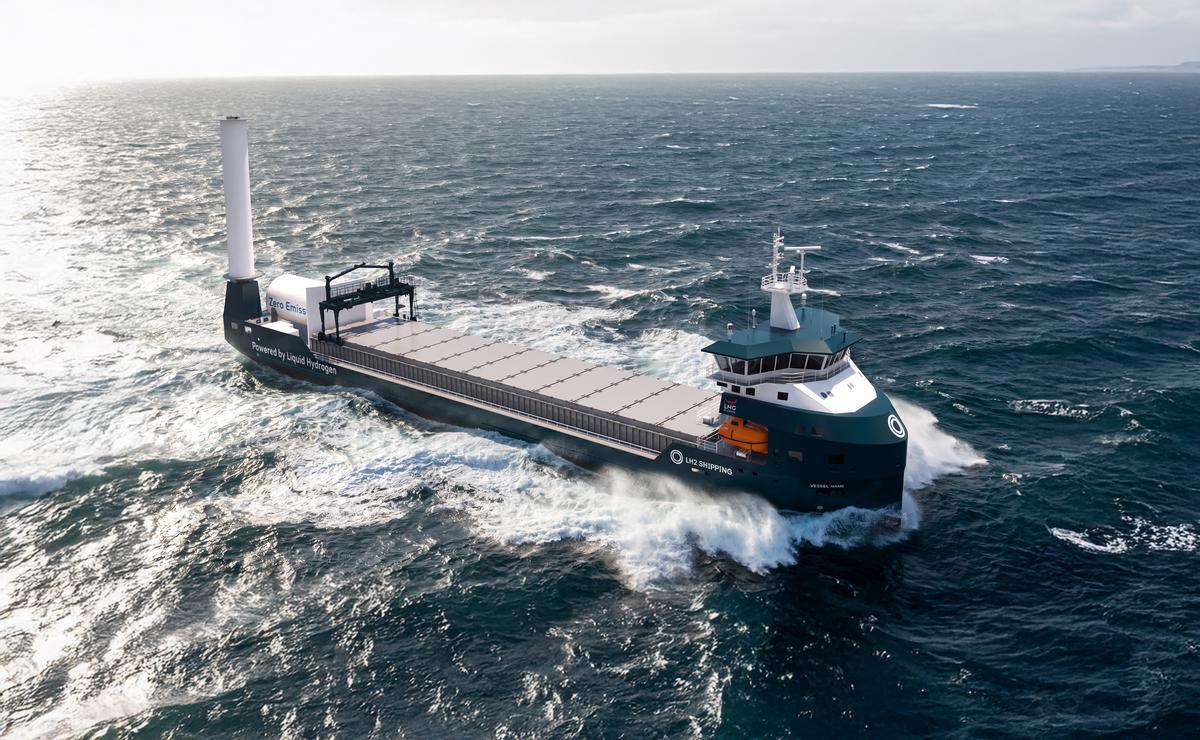 IMAGE: Concept of a liquid hydrogen-capable bulk carrier developed as part of the Strandbulk project. LH2 Shipping
Battery-electric vessels and shore-power infrastructure are expected to play an important role in short-sea and coastal shipping.
For more than a decade, Enova has supported several vessel types suited to electrification and hybridisation, including ferries, coastal fishing vessels, cargo ships and offshore and aquaculture service vessels.
But battery-electric propulsion will not meet the range and energy needs of ocean-going vessels, including long-distance cargo ships and fishing vessels, Enova said.
The agency has launched programmes to support green hydrogen and hydrogen-derived fuels such as ammonia as zero-emission options for long-distance shipping.
However, Enova said hydrogen-based shipping still lacks a functioning value chain, including sufficient production of green hydrogen and derived fuels such as ammonia, as well as the necessary distribution and bunkering infrastructure.
Enova said it is trying to address this chicken-and-egg problem by supporting multiple parts of the hydrogen value chain, providing vessel operators with access to sustainable fuel while giving fuel producers potential buyers.
The agency has invested in several hydrogen production and bunkering facilities along the Norwegian coast. It has also supported 11 hydrogen-powered vessels and 13 ammonia-powered vessels in recent years. However, significant uncertainty remains over what zero-emission shipping will look like by 2050, Enova said.
Its analysis projects Norway’s maritime emissions falling from 2.79 million mt of CO2 in 2025 to 1.48 million mt in 2050, but not reaching zero.
The agency said shipowners will not be able to use new fuels unless infrastructure for power, bunkering, production and distribution is developed in parallel with vessels.
Earlier this month, Enova awarded another NOK 1.3 billion ($132 million) to ten zero-emission shipping projects, including LH2 Shipping’s two liquid-hydrogen bulk carriers.
By Nachiket Tekawade
Please get in touch with comments or additional info to news@engine.online


