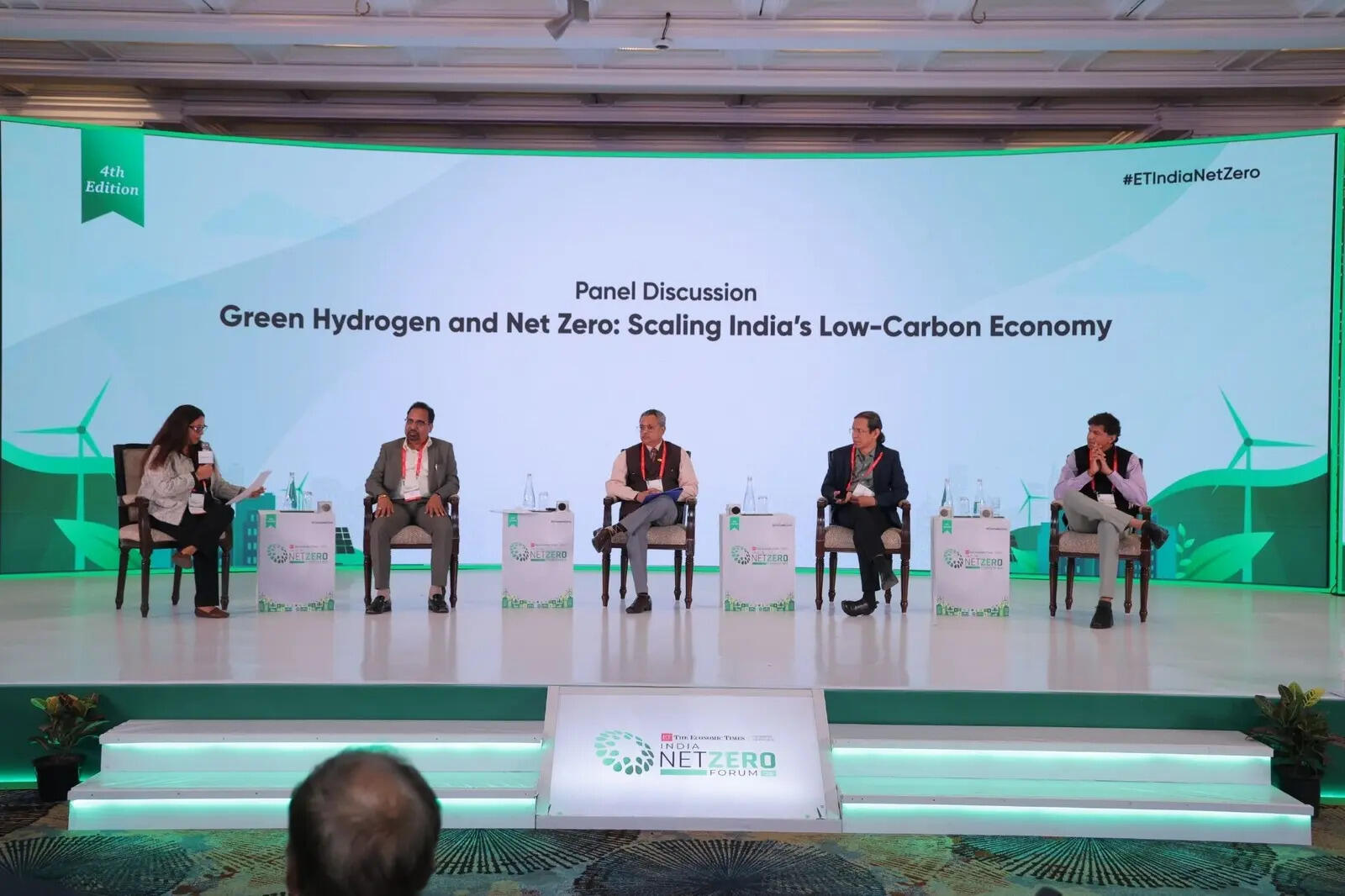
India’s green hydrogen economy will scale only when production is matched with commercially viable demand, competitive delivered costs and bankable offtake opportunities across end-use sectors, rather than through supply-side capacity creation alone, industry leaders said on Tuesday.
Speaking at the 4th Edition of The Economic Times India Net Zero Forum’26, they said the focus is now shifting from policy ambition and production targets to creating sustainable demand, improving cost competitiveness and developing an ecosystem that can attract long-term investment and support large-scale adoption.
DMR Panda, Executive Director-Hydrogen/RE and CEO-APNHAL, NTPC, said one of the biggest challenges is the expectation that emerging clean technologies must immediately compete with conventional alternatives on cost. He said the transition will require early adopters willing to pay for decarbonisation benefits while the ecosystem matures.
“All new clean technologies cannot be as competitive as conventional ones from day one,” he said.
Panda added that discussions around green hydrogen often focus solely on achieving parity with grey hydrogen prices without adequately valuing carbon reduction. He said carbon-linked incentives or credit mechanisms could help bridge this gap and accelerate adoption. Referring to NTPC’s green hydrogen hub at Pudimadaka in Andhra Pradesh, he said the project faces challenges typical of large industrial developments, as well as technology-specific issues related to ammonia, sustainable fuels, and vendor ecosystem development.
Asim Prasad, Executive Director, GAIL, said demand creation and delivered cost at the user end are the two most critical factors for scaling green hydrogen. While India already consumes 6-7 million tonnes of grey hydrogen annually, primarily in fertiliser and refinery applications, he said green hydrogen adoption will depend on either replacing existing demand or creating new use cases.
“There has to be demand for green hydrogen, either equivalent to or more than what is there for grey hydrogen,” Prasad said.
He added that hydrogen transportation requires a different infrastructure approach from natural gas because of its distinct properties. According to him, green hydrogen is currently consumed largely near the point of production globally, making hydrogen valleys and industrial clusters important models for developing local production, storage, transport and consumption ecosystems.
“Green hydrogen is largely used at the point where it is produced,” he said.
Prasad said trucks and cylinders could support short-distance movement, while pipelines may become viable over longer distances once sufficient demand emerges. For international trade, he said carriers such as ammonia, methanol, and liquid organic hydrogen carriers could be considered, though each would entail additional conversion costs.
SP Mohanty, Managing Director, Hindustan Urvarak & Rasayan Ltd (HURL), said the fertiliser sector could become a significant consumer of green ammonia, but adoption would depend on cost competitiveness within India’s subsidy-driven fertiliser framework. He said policy support and commercial viability must move together for investments to materialise.
“Until and unless it is cost competitive, no private investment or partner is coming to this group,” Mohanty said.
He added that green ammonia is gaining greater relevance as volatility in global energy markets raises concerns around conventional feedstocks. According to Mohanty, policy support for green ammonia is expected to improve, making the user ecosystem more conducive to adoption.
“Very soon, the policy will also be coming on green ammonia, and the user side will be much better,” he said.
Mohanty said the fertiliser industry could begin adopting green ammonia at scale by 2030, particularly if carbon-related costs increasingly influence global ammonia and fertiliser trade.
Vishnu Budama, CEO, Pune Hydrogen Valley Foundation, said hydrogen valleys can serve as practical platforms for demonstrating production, storage and utilisation models across the value chain. He said the Pune Hydrogen Valley project is placing greater emphasis on bio-based hydrogen production than conventional electrolysis alone.
“In the Pune hydrogen valley, we are going to produce 2,000 kg of hydrogen per day, out of which 1.7 tonnes is through the bio route,” he said.
Budama said the project plans to utilise ethanol from Maharashtra’s sugar industry to produce hydrogen and ethyl acetate, creating two revenue streams while linking farmers and ethanol producers directly with the clean energy economy. He also identified speciality chemicals as an early commercial opportunity because many such companies already pay premium prices for hydrogen.
“This industry is a low-hanging fruit. Today, we can replace grey with green because they are already paying green hydrogen price,” he said.
On domestic manufacturing, Panda said India has already developed alkaline electrolyser capability and that NTPC has contracted significant electrolyser capacity. Budama similarly noted that indigenous alkaline electrolyser technologies are improving and expected to gain greater market acceptance as deployment increases.
The panel also discussed international experiences, with Budama noting that Pune Hydrogen Valley is studying models such as Groningen Hydrogen Valley in the Netherlands to understand project design, public-private partnerships, and viability-gap support mechanisms. Prasad noted that hydrogen pipeline economics may eventually evolve along principles similar to those of regulated natural gas infrastructure, though scale will remain essential.
Panda further said green hydrogen adoption has already moved beyond the pilot stage in mobility applications. Referring to NTPC’s hydrogen bus deployments in Ladakh, he said demand for vehicles and refuelling infrastructure is growing steadily.
The discussion concluded with broad agreement that India’s green hydrogen ambitions will ultimately depend on creating sustainable demand, reducing delivered costs, supporting early offtakers, building localised industrial clusters and recognising the economic value of decarbonisation alongside production targets.