

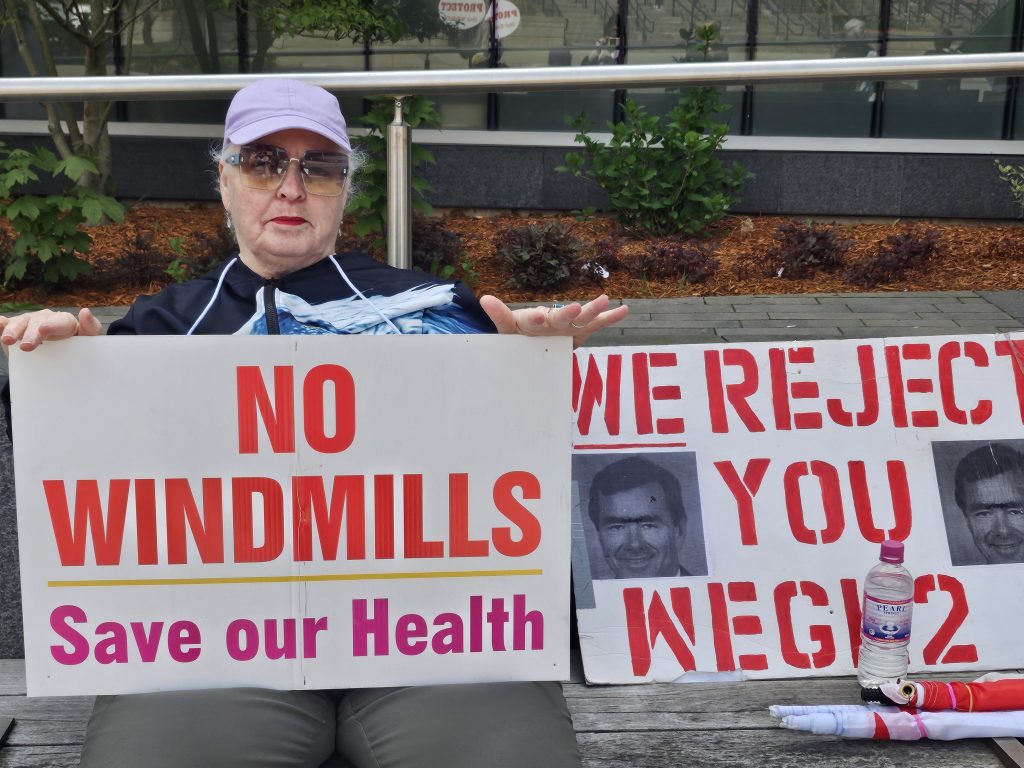
Wind energy will be central in this province’s green energy transition. But how can we make this land-intensive industry work for our communities and ecosystems? What would that look like in Newfoundland and Labrador?
The story of wind-to-hydrogen in Newfoundland and Labrador is in flux, with many indications that the wind has been taken out of its sails. Yet upheaval in energy markets, with war-induced supply constraints, complicates the green energy transition.
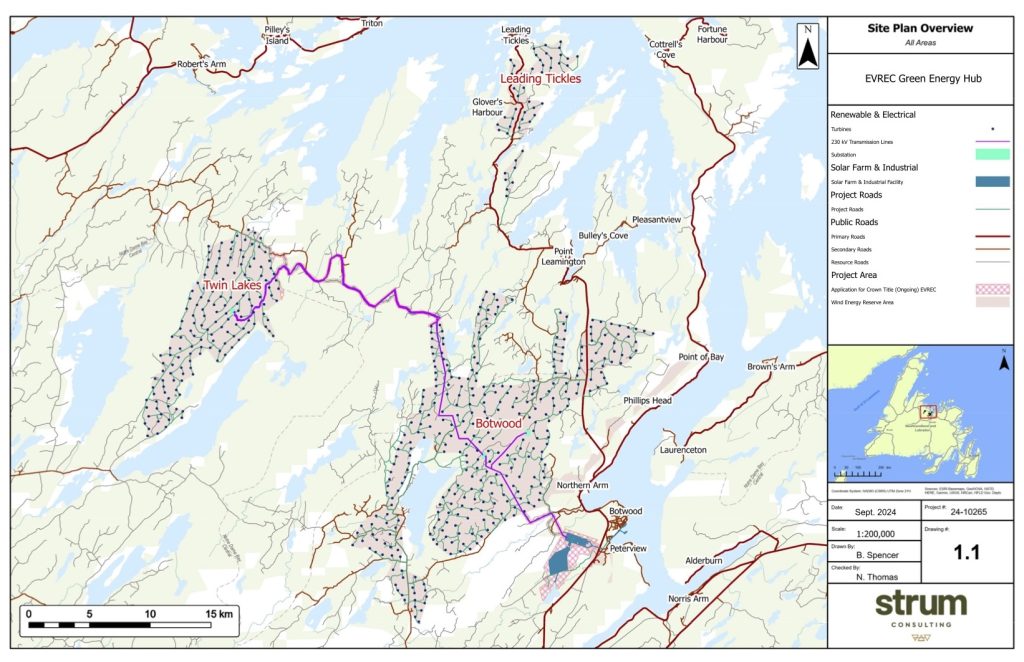
In February, the province evicted three wind-to-hydrogen companies for not paying the rent. Minister of Energy and Mines Lloyd Parrott ended the companies’ land access due to their “lack of progress” and failure to pay Crown lands reserve fees (a mere 3.5 per cent of the land’s market value). World Energy GH2 Limited Partnership, EverWind NL Company, and Toqlukuti’k Wind and Hydrogen Ltd. are done. Then, last month, Argentia Renewables (Pattern Energy) signalled it was no longer pursuing a wind-hydrogen project and will not be extending its Crown lands access which expired March 31, 2026. Meanwhile, on May 15, Exploits Valley Renewable Energy Corporation (EVREC) submitted its environmental impact statement for the Botwood and area EVREC Green Energy Project to the province, expecting sales to Europe by 2030. A relatively smaller project (340MW) spearheaded by the Green Energy Hub in Come-by-Chance is also moving ahead.
Beyond EVREC and the Green Energy Hub, companies formerly focused on wind-to-hydrogen now speculate on other uses of the province’s vast wind reserves. Data centres. Green steel manufacturing. A biomethanol plant. Subsea and overland transmission lines to send electricity through Québec to feed the voracious energy appetite of the northeastern United States.
Before we get swept up in another round of industry hype, let’s reflect on what can be learned (and gained) from this experience about Newfoundland and Labrador’s renewable energy transition.
From ban to bonanza to bust to resurgence?
The story of wind-to-hydrogen in this province is a recent but chaotic one.The provincial government banned wind farms in 2007, protecting NL Hydro’s monopoly on electricity generation, then lifted it in April 2022, just as World Energy GH2 was proposing the province’s first wind-to-hydrogen project. This came on the heels of the province’s Maximizing Our Renewable Future plan in late 2021 which noted hydrogen as a prominent use of wind energy.
In summer 2022, World Energy GH2’s Project Nujio’qonik was being hailed as the future for Newfoundland’s West Coast, especially for the Bay St. George area and the Port-au-Port Peninsula. The next month, German Chancellor Olaf Scholz and then-Prime Minister Justin Trudeau arrived to fanfare in Stephenville for the signing of the Canada-Germany Hydrogen Alliance Declaration of Intent, a words-only commitment to promote a hydrogen relationship. In October 2022, World Energy GH2 signed two MOUs with Qalipu First Nation and the Town of Stephenville to create industry training for Qalipu members and other opportunities for residents in the area.
More MOUs with European partners followed. Leaning on private firms to drive the province’s wind energy sector and shape environmental policy, the province rushed to release a Wind-Hydrogen Fiscal Framework in February 2023 and later a Hydrogen Development Action Plan in 2024. Similarly, the federal government developed a Clean Hydrogen Investment Tax Credit to foster investment by Canadian corporations in the emerging sector.
In August 2023, the Government of Newfoundland and Labrador gave four companies exclusive rights to crown lands to pursue wind-to-hydrogen projects and subsequently extended the Wind Energy Land Reserve Order three times. Five projects made it to the project description phase of the environmental assessment process, but only Project Nujio’qonik and the Green Hydrogen Hub successfully completed the assessments.
These projects all relied on hundreds of wind turbines to capture wind energy and convert that into hydrogen using technology that was often only in the development phase. If built, the turbines would be some of the largest in the world, making the projects even more unprecedented. Yet the projects were fizzling as rent arrears stacked up, until the province showed three projects the door.
What happened? And what can we learn for the next phase of Newfoundland and Labrador’s energy transition?
Mega wind, mega hype, mega impacts
The wind-to-hydrogen projects put the ‘hyper’ in hyperbole. Billion-dollar projects all, they are gargantuan in global terms. One of the now-kiboshed projects, World Energy GH2’s Project Nujio’qonik, proposed to build over 300 wind turbines – each of which would have been a whopping 200 meters tall – securing approximately 1,080 square kilometers of crown land from the province for wind farm, hydrogen production, and storage facilities. In contrast, the Town of Stephenville and the Port au Port Peninsula cover a combined area of approximately 298 square kilometers. As such, World Energy GH2’s project was poised to be the largest wind farm in Canada and one of the largest globally. Of the still-standing projects, EVREC proposes to build “one of the world’s largest energy transition projects” in Botwood.
Of course, large scale projects mean large scale impacts—and not all good. Proponents claimed massive benefits in the old refrain of hundreds, if not thousands, of jobs. World Energy GH2 alone promised to create over 2,000 direct and indirect jobs for Western Newfoundland in its registration documents. Each firm forecast thousands of jobs during the construction phase, followed by hundreds more in operations phases. They also speculated on myriad economic spinoffs and, in some cases, even direct payments to local communities through MOUs (such as with World Energy GH2). These are no doubt enticing to economically-desperate communities and provinces. Yet the consequences—community, environmental, and economic—could be equally massive.
Community risks
Turning rural communities into industrial zones has well-documented extensive and uneven community impacts—impacts that are particularly acute given that most of these projects are cited in rural communities of less than 10,000 people.
There are known safety and health risks associated with handling hydrogen and ammonia, a toxic substance. Problems associated with the large influx of workers required to build these projects are also well documented. The sudden increase in population for these small towns often compounds housing shortages and strains already over-burdened local services, including health and childcare. Meanwhile, worker camps — or “man camps” — have been linked to increased gender-based and sexual violence in surrounding communities.
The projects would also intensify traffic and noise from both increased volume of workers’ commute and increases in material transportation, including oversized transport trucks needed to move various parts of the massive turbines. Then, after the disruption of the construction phase, towns’ booms turn to bust as most jobs end. Left behind are communities that have been deeply changed. With no industry to support residents, communities are left to deal with the consequences of deepening inequalities, potentially worsening mental health, and gender inequality.
Environmental risks
The expansive infrastructure required for these large-scale projects—wind farms, roads, transmission lines, electrolysis plants, shipping ports—damage and disturb lands and waterways. The wind-to-hydrogen projects present significant risks and uncertainty to ecosystems and biodiversity, impacting already vulnerable species.
The areas of Newfoundland earmarked for development are located within the boreal zone, which includes a mix of forest and extensive peatlands. Projects in Western Newfoundland also aimed to place green energy infrastructure at the doorstep of the limestone barrens; for instance, Project Nujio’qonik on the Port au Port Peninsula proposed a wind farm whose footprint was intertwined with the southernmost limestone barren habitat in western Newfoundland. These ecologically unique ecosystems support multiple endangered or threatened plant species, some of which are found only in Newfoundland, but whose habitat is easily degraded by the construction of roads and buildings.
Boreal peatlands such as bogs and fens — which contain disproportionately large stores of global soil carbon — are also highly sensitive to disturbance. Infrastructure development in peatlands often results in significant changes in vegetation composition and the release of greenhouse gasses from these important ecosystems. Likewise, the fragmentation in boreal rivers can negatively impact the migration of species such as salmon. Boreal ecosystems in Newfoundland are already experiencing multiple stressors due to climate change, spruce budworm outbreaks, and forest fires. Large-scale wind projects would have added an additional complication to an already stressed system.
Finally, given the long lifecycle of these mega wind farms, with investments and operation spanning decades, these cumulative impacts will deepen and intensify through time, making the future of these ecosystems increasingly difficult to predict.
Economic risk
It’s important to remind ourselves that the mega wind-to-hydrogen projects on the table would create a new export-dependent commodity sector. Beneath the green veneer, shipping hydrogen boils down to exporting a raw material to world markets, useful either as an energy carrier or a chemical feedstock. So far, three projects stalled and died for a simple reason: European demand for the commodity didn’t emerge, so investments never materialized.
Creating hydrogen from wind energy is an energy-intensive and therefore high-cost process; doing it in Newfoundland whilst demand is in Europe implies high shipping costs, making the business case poor. What’s more, European buyers are reluctant to be locked into long-term contracts with Canadian suppliers when other regions in the world — like Southern Europe, North Africa, and the Middle East — may be able to produce hydrogen at a cheaper rate within a decade or so. Put simply, there are significant cost barriers for shipping green hydrogen from Newfoundland to Europe.
Locking in Newfoundland and Labrador’s future renewable energy economy on an export-dependent sector is both economically and socially perilous. It leaves the province dependent on the energy needs of Europe and on the willingness of financiers to invest. More broadly, the government’s focus on these projects distracts from pursuing other more beneficial options.
From ‘green transition’ to ‘just transition’
The wind keeps blowing. The need for energy transition keeps growing. While Newfoundland and Labrador has world-class wind energy potential, as of 2023 it continued to rank last amongst Canadian provinces for wind energy generation. What might a more socially sustainable and ecologically just energy transition resemble, if we were to leave the mega-project model behind?
We know Canada, like the rest of the world, needs to transition away from fossil fuels to mitigate the worst effects of climate change, species loss, and other environmental crises already underway. Beyond the need to decarbonize, there is also a need for green energy projects to move away from a reliance on big funders and finicky markets that don’t have our communities’ interests in mind. The current mega-wind model being piloted in Newfoundland and Labrador — characterized by massive developments, increasingly backed by billionaires and venture capital, lacking community benefits and meaningful, informed consent from local residents — is not the answer.
We need projects to provide benefits here and now, as remote and rural communities struggle while growing income inequity hinders people’s ability to thrive. Beyond a green transition, we need a just transition.

A just transition is a renewable energy economy model that requires social and cultural shifts to better support labour rights for workers within the energy sector, healthy ecosystems, and more equitable societies. With this framework, which emerged out of labour organizing, benefits are shared equally among all members of society and there is recognition of local impacts and costs to the communities hosting the energy projects. In other words, a just transition limits community and environmental impacts of energy projects, including gender violence and environmental racism.
Under a just transition framework, wind project proposals would prioritize local community needs and ecological resilience over corporate profit or foreign energy markets. A just transition could be shaped by community-led energy developments that balance technological efficiency with local needs and landscapes — pairing, for instance, local job creation with benefit agreements to invest in social infrastructures (schools, hospitals, arts and culture) needed to create healthy, vibrant communities where people want to live.
A just transition would make sure the economic effort of building up a community-led wind sector in Newfoundland and Labrador would sustain and nourish the development of local industries able to design, manufacture and maintain these infrastructures instead of depending on imports.
It’s clear that the province is capable of producing enormous amounts of wind energy. The challenge, however, is how to tap this resource to spark a just transition that serves communities’ energy and economic needs for the long term.


