

No electrolyzers, no power consumption and no grid connection required – photreon, a founding project of the Karlsruhe Institute of Technology (KIT), wants to advance the hydrogen economy with mass-produced photoreactor panels. The panels make it possible to produce hydrogen from sunlight and water in a cost-effective and scalable way – suitable for both decentralized applications and large plants in sunny regions.
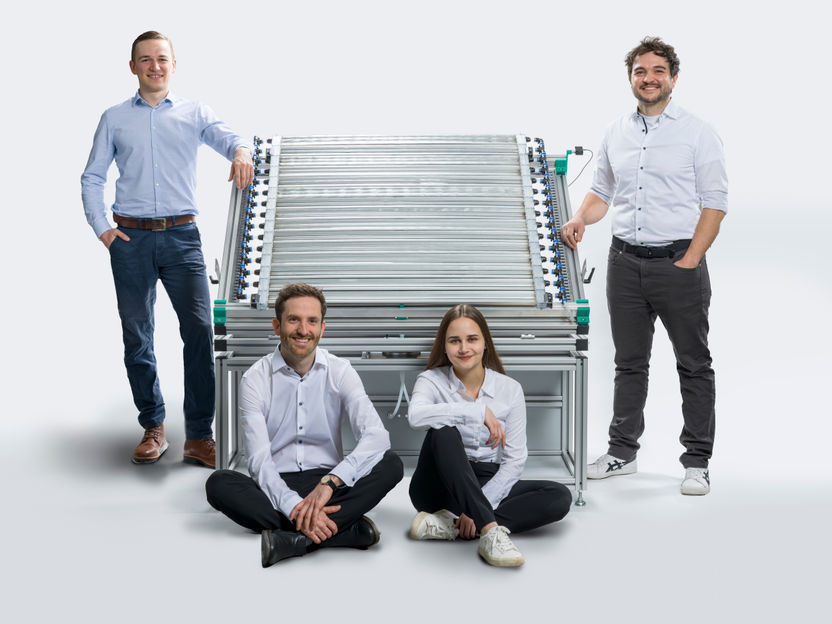
The photreon team in front of the one-square-meter prototype of the photoreactor panel for the production of pure solar hydrogen. From left to right: A. Dreher, P. Kant, M. Cordts, M. Rubin.
Amadeus Bramsiepe, KIT
Green hydrogen is seen as the key to the climate-friendly transformation of industry and the energy system. Until now, however, its production has been expensive, complex and tied to network infrastructures. This is precisely where photreon comes in: The founding project from KIT is developing a photoreactor panel that produces hydrogen directly from sunlight and water – without electrolyzers and without electrical energy. “We skip the detour via electricity-based electrolysis and produce chemical energy from sunlight and water,” says co-founder Paul Kant from the Institute of Micro Process Engineering (IMVT) at KIT. With their modular panels, solar hydrogen production can be significantly simplified and economically scaled.
Direct solar conversion instead of a detour via electricity
The photreon approach is based on the principle of photocatalysis – a technology in which light is not used to generate electricity as in photovoltaics, but instead directly triggers a chemical reaction. Specially developed, light-active materials absorb the energy of solar radiation and put electrons into an excited state. These charge carriers drive the splitting of water (H₂O) into hydrogen (H₂) and oxygen (O₂). “Photovoltaics and electrolyzers are replaced by the photoreactor panel in a single process step,” says Maren Cordts from IMVT, who is also a co-founder, explaining the underlying principle. “This significantly reduces system costs and complexity in the production of green hydrogen.”
photreon is now technically implementing this approach in a photoreactor panel for which KIT has filed a patent application. Thanks to its special design, the panel enables the targeted guidance of sunlight to the active material inside, where it is optimally illuminated and water splitting takes place. “We designed the reactor geometry in such a way that light transport, chemical reaction and removal of the products interact optimally and were thus able to demonstrate hydrogen production in our one-square-meter prototype,” says Kant. The design is also consistently geared towards series production using standard mass production processes and can be manufactured from low-cost materials. Thanks to the modular approach, it can be used on a small scale as well as interconnected to form larger areas.
From rooftop systems to hydrogen solar parks
The panels can be used where hydrogen is currently too expensive or logistically difficult to provide: at medium-sized companies that will be able to cover their needs directly on site in the future – for example in the specialty chemicals, food or metal processing industries – as well as in large-scale solar projects in regions with high levels of solar radiation. “Our technology opens up new scope for local generation, especially in places where there are neither electricity grids nor a connection to a hydrogen network,” says Cordts. Possible applications range from the decentralized supply of individual production sites to industrial production in sunny regions for the international market.
Note: This article has been translated using a computer system without human intervention. LUMITOS offers these automatic translations to present a wider range of current news. Since this article has been translated with automatic translation, it is possible that it contains errors in vocabulary, syntax or grammar. The original article in German can be found here.


