

The hydrogen electrolyzer market is rapidly emerging as a cornerstone of the global clean energy transition. Electrolyzers are devices that split water into hydrogen and oxygen using electricity, enabling the production of green hydrogen when powered by renewable energy sources such as solar and wind. This technology is gaining immense traction as countries and industries aim to reduce carbon emissions and achieve net-zero targets.
With increasing environmental concerns, government incentives, and advancements in hydrogen technologies, electrolyzers are becoming a key enabler of sustainable energy systems. Industries such as transportation, chemicals, steel, and power generation are adopting hydrogen-based solutions, positioning the hydrogen electrolyzer market for exponential growth.
Download Sample Report: https://www.cervicornconsulting.com/sample/2479
________________________________________
Market Size
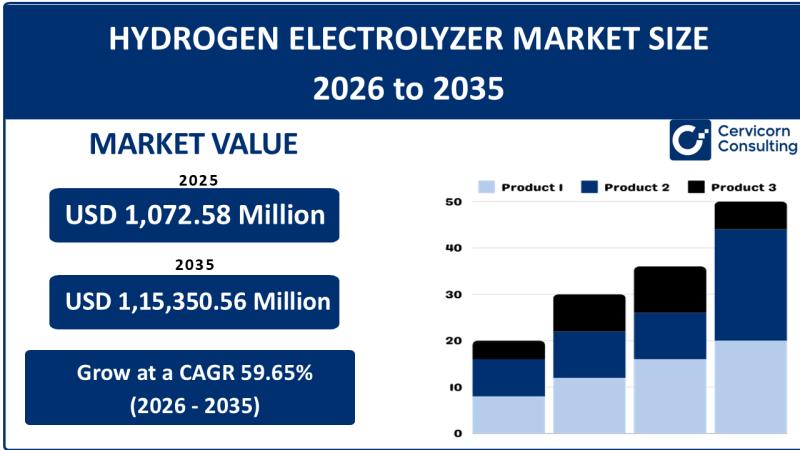
The global hydrogen electrolyzer market size was valued at USD 1,072.58 million in 2025 and is projected to surpass around USD 1,15,350.56 million by 2035, expanding at a compound annual growth rate (CAGR) of 59.65% over the forecast period 2026 to 2035.
This rapid growth is fueled by increasing investments in green hydrogen production, declining renewable energy costs, and strong policy support worldwide. The market’s explosive CAGR highlights its transition from a niche technology to a mainstream energy solution.
________________________________________
Current Market Trends
1. Shift Toward Green Hydrogen
A major trend is the transition from fossil-fuel-based hydrogen (grey hydrogen) to green hydrogen produced via electrolysis. This shift aligns with global decarbonization goals.
2. Integration with Renewable Energy
Electrolyzers are increasingly integrated with solar and wind farms, enabling efficient use of surplus renewable energy and supporting grid stability.
3. Gigawatt-Scale Hydrogen Projects
Large-scale hydrogen projects are being developed across Europe, Asia-Pacific, and the Middle East, significantly boosting electrolyzer demand.
4. Technological Advancements
Innovations in Proton Exchange Membrane (PEM), alkaline, and solid oxide electrolyzers are improving efficiency, scalability, and cost-effectiveness.
5. Rising Private Investments
Private sector investments and venture capital funding are accelerating commercialization and technological innovation in electrolyzer systems.
________________________________________
Market Drivers
1. Global Decarbonization Goals
Governments worldwide are implementing strict emission regulations and net-zero targets, driving demand for clean hydrogen solutions.
2. Growing Renewable Energy Capacity
The rapid deployment of renewable energy sources provides cost-effective electricity for hydrogen production, enhancing electrolyzer adoption.
3. Industrial Demand for Clean Hydrogen
Industries such as steel, ammonia, and chemicals are increasingly adopting hydrogen to reduce carbon footprints.
4. Expansion of Hydrogen Infrastructure
The development of hydrogen refueling stations and storage systems is supporting market growth.
5. Advancements in Electrolyzer Efficiency
Technological improvements are reducing energy consumption and operational costs, making electrolyzers more competitive.
________________________________________
Market Restraints
1. High Capital Investment
Electrolyzer systems require significant upfront investment, limiting adoption among small and medium enterprises.
2. Limited Hydrogen Infrastructure
Insufficient infrastructure for hydrogen storage, transport, and distribution remains a major challenge.
3. High Operational Costs
Electrolysis requires substantial electricity, increasing operational expenses, especially in regions with expensive energy.
4. Competition from Conventional Hydrogen
Grey and blue hydrogen, produced from fossil fuels, remain cheaper alternatives, hindering market penetration.
5. Technical Challenges
Scaling up electrolyzer technologies for large industrial applications remains complex.
________________________________________
Market Opportunities
1. Emerging Hydrogen Economy
The global push toward a hydrogen-based economy presents significant growth opportunities for electrolyzer manufacturers.
2. Government Incentives and Policies
Initiatives such as subsidies, tax credits, and hydrogen missions are encouraging market expansion.
3. Expansion in Emerging Markets
Regions like Asia-Pacific, Latin America, and the Middle East are investing heavily in hydrogen infrastructure.
4. Integration with Energy Storage Systems
Electrolyzers can store excess renewable energy in the form of hydrogen, addressing intermittency issues.
5. Growth in Fuel Cell Vehicles
The increasing adoption of hydrogen-powered vehicles is boosting demand for electrolyzer-produced hydrogen.
Download Sample Report: https://www.cervicornconsulting.com/sample/2479
________________________________________
Market Segmentation
The hydrogen electrolyzer market is segmented based on product type, capacity, output pressure, and application.
By Product Type
• Proton Exchange Membrane (PEM) Electrolyzer
• Alkaline Water Electrolyzer
• Solid Oxide Electrolyzer
• Anion Exchange Membrane Electrolyzer
PEM electrolyzers held the largest share of around 48% in 2024 due to their efficiency and flexibility.
By Capacity
• Low (2 MW)
The low-capacity segment dominated with a 41% revenue share in 2024, driven by decentralized applications.
By Output Pressure
• Low (Up to 10 Bar)
• Medium (10-40 Bar)
• High (>40 Bar)
By Application
• Ammonia Production
• Methanol Production
• Refinery Industry
• Electronics
• Energy & Power-to-Gas
• Transportation
Applications in ammonia and energy storage are particularly significant due to their role in industrial decarbonization.
________________________________________
Regional Market Insights
Asia-Pacific
Asia-Pacific dominates the market with nearly 39.7% revenue share in 2024, driven by countries like China, Japan, South Korea, and Australia.
These nations are investing heavily in hydrogen infrastructure and clean energy technologies.
Europe
Europe is a key market supported by strong government policies, sustainability goals, and large-scale hydrogen projects.
North America
North America is witnessing rapid growth due to increasing investments in hydrogen technologies and supportive policies.
Latin America, Middle East & Africa (LAMEA)
These regions are emerging markets with significant potential due to growing energy demand and renewable resource availability.
Get the Full Report@ https://www.cervicornconsulting.com/hydrogen-electrolyzer-market
________________________________________
Key Market Players
The hydrogen electrolyzer market is highly competitive, with several global players focusing on innovation and expansion. Key companies include:
• Air Liquide
• Siemens AG
• Plug Power Inc.
• ITM Power Plc
• McPhy Energy
• Nel Hydrogen
• Ballard Power Systems
• Enapter
• Green Hydrogen Systems
These companies are investing in research and development, strategic partnerships, and large-scale projects to strengthen their market positions.
________________________________________
Future Market Growth Potential
The future of the hydrogen electrolyzer market is extremely promising, driven by:
• Increasing global commitment to net-zero emissions
• Expansion of renewable energy infrastructure
• Rising demand for green hydrogen across industries
• Technological advancements reducing costs and improving efficiency
• Growth of hydrogen-powered transportation
Large-scale hydrogen hubs, gigawatt electrolyzer projects, and international collaborations are expected to accelerate market growth significantly. As technology matures and costs decline, electrolyzers will become a mainstream solution for clean energy production.
________________________________________
Frequently Asked Questions (FAQ)
1. What is a hydrogen electrolyzer?
A hydrogen electrolyzer is a device that uses electricity to split water into hydrogen and oxygen through electrolysis.
2. What is driving the hydrogen electrolyzer market?
Key drivers include decarbonization goals, renewable energy expansion, industrial demand, and government support.
3. Which region dominates the market?
Asia-Pacific currently leads the market, followed by Europe and North America.
4. What are the main challenges in the market?
High costs, limited infrastructure, and competition from conventional hydrogen production methods are major challenges.
5. What is the future of the hydrogen electrolyzer market?
The market is expected to grow exponentially, driven by green hydrogen adoption and technological advancements.
________________________________________
Conclusion
The hydrogen electrolyzer market is at the forefront of the global energy transition, enabling the production of clean hydrogen and supporting decarbonization across multiple industries. Despite challenges such as high costs and infrastructure limitations, strong government support, technological innovation, and rising demand for sustainable energy solutions are driving rapid market expansion.
As the world mov es toward a low-carbon future, hydrogen electrolyzers will play a pivotal role in reshaping the energy landscape, offering immense growth opportunities for stakeholders across the value chain.
Buy now at a 15% discount price: https://www.cervicornconsulting.com/buy-now/2479
Office No – 609, 6th Floor, 129/A Dattawadi, Sinhgad Road, Pune – 411030, India
Cervicorn Consulting is a global market research and consulting firm that provides syndicated research reports, industry insights, and customized consulting services across multiple sectors. The company focuses on delivering strategic market intelligence to help organizations make informed business decisions and identify emerging growth opportunities.
This release was published on openPR.


