

Hydrogen is often discussed as the future of clean energy, but the problem is that making it is expensive. Right now, the best tools we have for the job rely on noble metals like platinum. Since platinum isn’t cheap or easy to find, it keeps the cost of hydrogen production high and stops it from being used everywhere.
To fix this, researchers at the University of Jyväskylä (JYU) are looking at semiconductors. These materials are much more common and affordable than precious metals. However, we don’t actually understand how they work on a microscopic level as well as we do with metals.
“Unlike traditional metal-based catalysts, semiconductor materials can utilize more common and less expensive elements,” explained Professor Karoliina Honkala and Senior Lecturer Marko Melander. “However, the development of semiconductor electrodes has been slowed down by the fact that their electrochemical and catalytic properties are not well understood.”
Breaking the Rules of Metal
The JYU team decided to tackle this knowledge gap by creating a new computational method. They called it “constant inner potential density functional theory.” While it sounds complicated, this essentially allows scientists to simulate how semiconductors behave when you add electricity to the mix, something that used to be difficult to model.
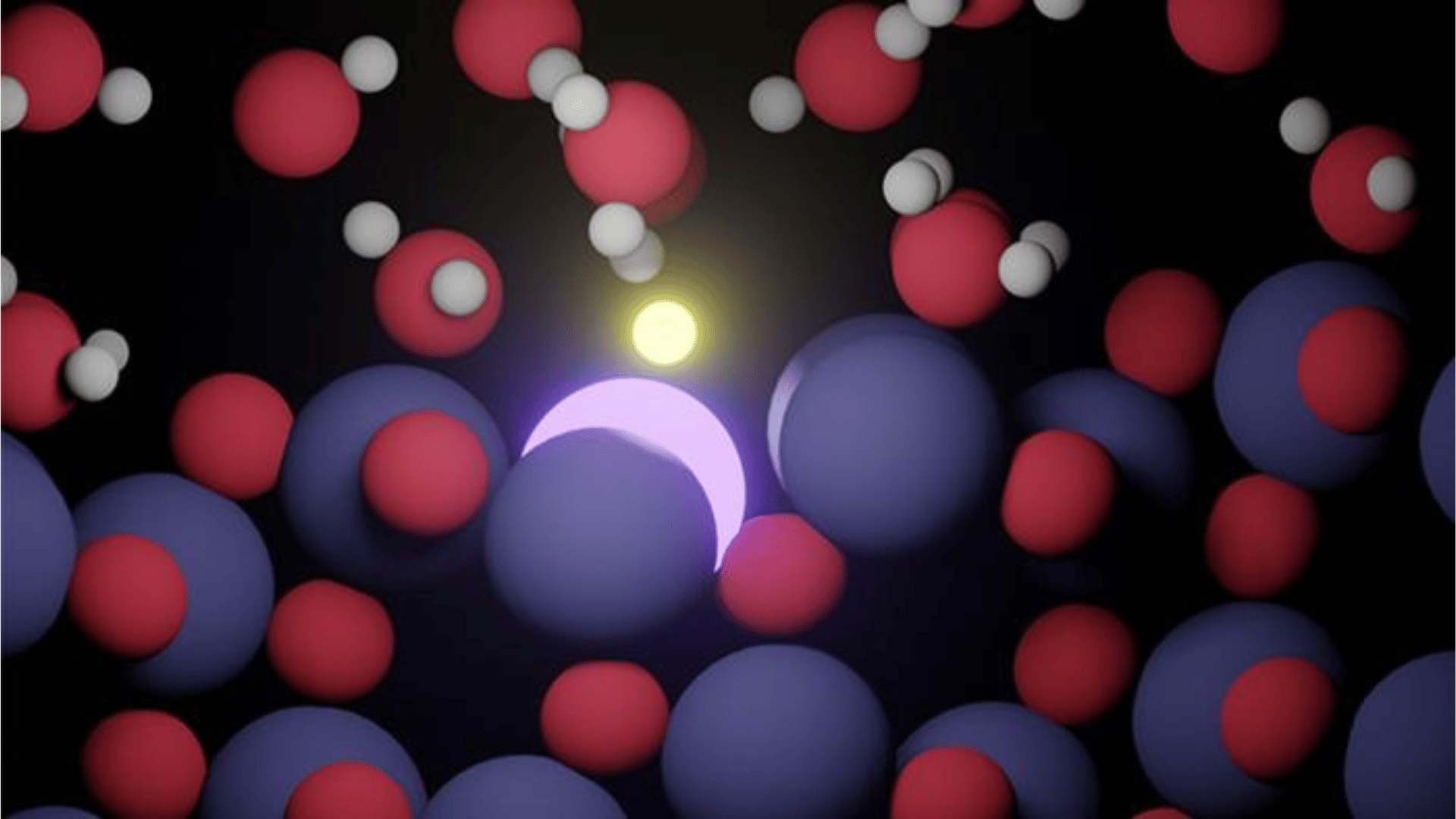
When they tested this on a titanium dioxide (TiO2) electrode, they found something unexpected. Instead of behaving like a metal, the semiconductor formed “polarons,” which are little pockets of local charge on the surface. These polarons are what actually drive the reaction to create hydrogen.
“We developed this method two years ago, and it opens new possibilities for modeling semiconductor electrodes. In the present study, we applied the method to the study of the hydrogen evolution reaction on a TiO2 semiconductor electrode,” Melander said. “Our simulations showed how and why changing the electrode potential achieves hydrogen production on TiO2.
Melander added, “Through the calculations made in collaboration with our partners, we predicted that local charge centers, polarons, form on the TiO2 surface and catalyze the hydrogen evolution.”
The Future of Hydrogen Production
This discovery is significant because metals are stuck following “scaling relations.” These are essentially physical laws that limit how efficient a metal catalyst can be. Because semiconductors create these polarons, they might be able to bypass those limits entirely.
Experiments confirmed the theory was right, proving that we can control these charge centers just by changing the electrode potential. This opens up a whole new path for designing catalysts that don’t rely on expensive metals.
“We found that the formation of polarons enables semiconductor electrodes to avoid the so-called scaling relations. On metallic electrodes, these laws limit and constrain the achievable catalytic activity,” said Honkala and Melander. “Our discovery of the potential-dependent polaron formation may lead to new approaches to avoid the scaling relations and thereby improvement in catalyst design.”


