

Analyst data estimates that the low-emissions hydrogen industry either committed to final investment decisions or started building around a million tonnes per year of production capacity in 2025, but cancelled over 4.9 million tonnes’ worth. In most of the world, industry is curbing its ambitions as it struggles to find buyers willing to pay a premium for renewable hydrogen. Meanwhile, Chinese companies are making fewer high-profile advance announcements and building the majority of projects globally.
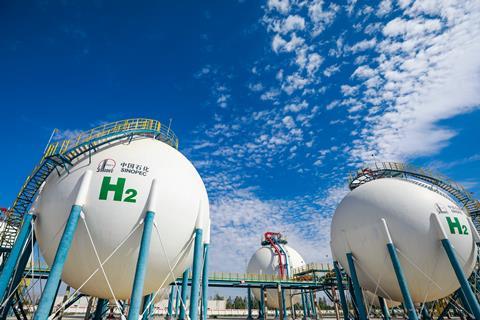
Michael Barnard, chief strategist at The Future Is Electric Strategy, is very pessimistic about using low-emissions hydrogen as a fuel, energy source or energy storage medium. Instead, it is ‘essential as a chemical feedstock’, he says. It will also be important in ‘hard-to-abate’ sectors where it’s otherwise difficult to eliminate fossil fuels and prevent greenhouse gas emissions, like making steel and ammonia. Synthetic fuels such as for shipping and aviation might remain as a further application, adds Adrian Odenweller, from the Potsdam Institute for Climate Impact Research (PIK), Germany.
Green hydrogen blues
Most hydrogen currently comes from fossil fuels, mainly through steam methane reforming, which converts methane and steam into hydrogen along with carbon monoxide and carbon dioxide. Energy market analysts Montel put the cost of this ‘grey’ hydrogen at €1–2 (£0.9–1.8) per kilogram. The first of two main types of low-emission hydrogen technology currently being deployed, blue hydrogen, typically captures and stores the carbon dioxide emissions from reforming. Montel puts the cost of blue hydrogen at €1–3 per kilogram.
For green hydrogen, companies usually electrolyse water using renewable electricity, separating it into hydrogen and oxygen. As such, the scale of green hydrogen projects are often judged by the power they consume in megawatts or gigawatts, as well as the amount of hydrogen they will produce in tonnes per year. Costs range from €3 to €7 per kilogram, depending on many factors such as renewable electricity prices – since electricity is a significant portion of the ongoing cost of running an electrolyser plant. Such costs limit green hydrogen’s application where other defossilisation options are available, such as direct electrification powered by renewables.
After a flurry of high-profile announcements, companies cancelled close to 60 major clean hydrogen projects in 2025, according to data from S&P Global provided to the Financial Times. Together these projects would have produced over 4.9 million tonnes of hydrogen each year. British-based oil giant BP made two major cancellations, both notable for different reasons. In December 2025, it cancelled the large 1.5GW Duqm Green Hydrogen Project in Oman, which was due to produce 150,000 tonnes of hydrogen annually.
A lot of lofty project announcements […] were probably not realistic
Also in early December, BP cancelled the H2Teesside 1.2GW blue hydrogen project in Immingham, UK. Due to produce 160,000 tonnes of hydrogen per year, it had been part of the £9 billion Northern Endurance Partnership carbon capture scheme. BP reportedly lost out in its attempt to compulsorily purchase a plot of land for the project to an ‘AI growth zone’ after disagreement over priorities between government departments. Potential hydrogen demand on Teesside had fallen with the closure of Sabic’s ethylene cracker. US-based Air Products had also already paused its plan for a Teesside import facility linked to the largest green hydrogen and ammonia project being built so far, its 2.2GW Neom facility in Saudi Arabia.
Barnard is highly sceptical about Neom’s viability. He also compares the H2Teeside project to the Teesside Gigapark 1GW battery storage project announced in 2025. Both are ‘absurd scale infrastructure’ he says. But whereas the blue hydrogen project ‘didn’t make economic sense and was cancelled’ the battery project ‘makes tremendous economic and energy sense’.
Odenweller highlights Luxembourg-based steel giant ArcelorMittal’s cancellation of a green-hydrogen fired direct-reduced iron plant in Germany. The German government had pledged €1.3 billion (£1.1 billion) in subsidies to support it, as long as construction began in June 2025. ArcelorMittal was unable to commit to this while European electricity prices are high and the continent is importing cheap steel, without tariffs against high-carbon emission products. The EU started to phase in such tariffs in its Carbon Border Adjustment Mechanism in January.
European ambition falters
Odenweller says that together these issues create massive uncertainty over what green hydrogen will cost. That uncertainty is preventing potential buyers from committing to the contractual ‘offtake’ agreements that would give producers the financial reassurance needed to build, he says. Another part of the uncertain cost is that the price of electrolysers used to make green hydrogen, mainly proton-exchange membrane or alkaline cells, remains stubbornly higher than many people expected. Odenweller says that this is partly because they are not as easy to scale up as had been thought, with each new production plant incurring significant costs on bespoke engineering.
Another reason is uncertainty over related government policies, such as the EU’s Renewable Fuel of Non-Biological Origin (RFNBO) rules, which include hydrogen. Although they set mandates for hydrogen use, the RFNBO requirements for tracking greenhouse gas emission savings are strict and difficult-to-meet, including recording when and where the hydrogen is made. While industry is resisting the rules, Odenweller notes that they remain important.
‘It’s quite tricky and intricate,’ he says. ‘Most of the details have only been clarified recently and that obviously leads to delay. We must have some regulation that really ensures that producing hydrogen actually does decrease the emissions and doesn’t increase them.’
There’s no shortage of demand if we focus on where we actually need it
Together with his (PIK) colleague Falko Ueckerdt, Odenweller tracks the progress of green hydrogen projects from announcement to construction. They found that in 2023 only 7% were finished on schedule. In a recent update, the PIK researchers found that this decreased to 4% in 2024.
The PIK duo base their analysis on the International Energy Agency (IEA) Hydrogen Production and Infrastructure Projects Database. Of the projects that are not completed, ‘most projects get delayed, but many also simply disappear’, Odenweller says. ‘A lot of lofty project announcements that are still away in the future were probably not realistic.’ The projects that enter the database furthest in advance of their expected construction are most often in Europe, while those in Asia enter nearer to their construction date.
China delivers
The short delay between announcement and construction in Asia indicates a straightforward approach that sees China currently constructing the most low-carbon hydrogen projects. 59 projects started construction worldwide in 2025, according to data provided to Hydrogen Insight by Wood Mackenzie. These projects will reportedly produce an estimated one million tonnes of hydrogen per year, which is higher than the capacity of projects that began construction in 2024.
China accounts for about half of this output, with 25 projects that started construction, including five of the six largest. A methanol, aviation fuel and chemicals plant being built energy firm Ningxia Jiaze in Heilongjiang Province is the dataset’s largest green hydrogen plant. It will use waste straw biomass as feedstock and produce 107,000 tonnes/year of green hydrogen to feed directly into chemical production.
Green hydrogen will end up decarbonising ammonia, some methanol and some iron, but that won’t be done in Europe
The largest overall project that Hydrogen Insight reports as having started in 2025 was CF Industries’ Blue Point Complex in Louisiana, US, which is due to produce 1.4 million tonnes/year of ammonia using an estimated 247,000 tonnes/year of blue hydrogen.
While Chemistry World was unable to verify that construction has started, CF and partners Mitsui and Jera announced a final investment decision and a plan to start building the ammonia plant in 2026, ‘with low-carbon ammonia production expected in 2029’. CF has partnered with 1PointFive, a subsidiary of oil and gas producer Occidental, to transport and sequester 2.3 million tonnes of CO2 per year in Louisiana.
Also in the US, LSB Industries’ El Dorado Ammonia plant completed a well into which it intends to inject CO2 from its estimated 60,000 tonnes/year of blue hydrogen production, sequestering it in a nearby underground saline aquifer. Infineum’s US Project Roadrunner, due to make 23,000 tonnes of e-fuels annually for aviation, also started construction. It will use a 100MW electrolyser to make green hydrogen, reacting it with carbon dioxide captured from local industry to make low-emission e-fuels.
Huge, but not as huge as hyped
ExxonMobil freezing its plans to build a 900,000 tonne/year blue hydrogen plant to fuel its olefins plant in Baytown, US, is typical of many similar cancellations. The US government withdrew $330 million (£245 million) in funding for the project, as part of its scaling down of clean energy support. Several plants are nevertheless proceeding to construction. In Europe, OMV’s UpHy in Austria is already running a small (10MW, 1500 tonnes/year) electrolyser, feeding into its refinery in Schwechat. In 2025, construction began on a 140MW electrolysis plant at a grid substation in nearby Bruck an der Leitha, which OMV says will deliver up to 23,000 tonnes/year of hydrogen to Schwechat refinery through an underground pipeline once completed in late 2027. Norway began the second largest number of clean hydrogen projects of any country in 2025, with seven.
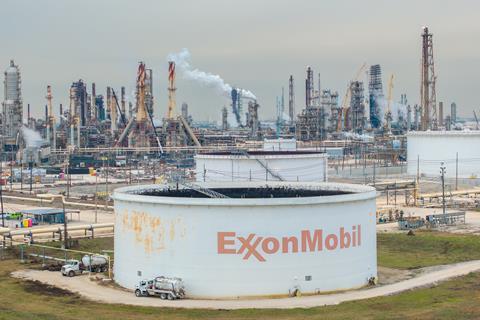
Barnard predicts that in future, hydrogen use will ‘plummet’, especially in Europe. ‘The primary use case for hydrogen today is refining petroleum into fuels,’ he stresses. Such fossil fuel demand must cease if the world is to slow global heating. ‘Green hydrogen will end up decarbonising ammonia, some methanol and some iron, but that won’t be done in Europe,’ Barnard asserts. ‘Instead, it will be done where it’s possible to have committed mass renewables parks along with water, and in the case of iron, iron ore. Methanol will be mostly made from biomass as that’s the cheapest process, but I’m sure some will be synthesised.’
Odenweller notes that the EU has a target of reaching 1.2% of aviation fuel being e-fuel by 2030. ‘That’s in four years, so you better start constructing these plants now,’ he says. ‘That doesn’t appear to be happening. Industry might be betting on those regulations being watered down again.’
In 2017, the Hydrogen Council industry association forecast that the gas would deliver about a fifth of the world’s carbon emission reductions by 2050, Odenweller recalls. Today, the IEA’s scenario for net-zero emissions by 2050 says that hydrogen might meet around 3% of the world’s energy needs, with another 1% coming from ammonia made with clean hydrogen and 2% as e-fuels. ‘Fundamentally, batteries and photovoltaics have exceeded expectations,’ Odenweller says. Yet the need for hydrogen remains ‘huge’ in sectors where there is no alternative, he adds. ‘Hydrogen is still going to be scarce for the chemical industry or steel production. There’s no shortage of demand if we focus on where we actually need it.’


