

The world needs steel for almost everything and global production continues to grow. However, making steel involves a carbon-heavy process that produces as much as 9.0 per cent of all human-based CO2 emissions.
Efforts to reduce the emissions associated with the traditional method of steel fabrication using coke-fired blast ovens have directed attention towards the production of “green steel.”
The process is defined more precisely as the hydrogen-based direct reduction of iron (H₂-DRI), followed by melting in renewable-powered electric arc furnaces (EAFs). Here, green H2 replaces CO as the reducing agent. This produces H2O instead of CO₂, while electricity supplies the melting energy.
As promising as the movement towards EAFs and green H2 have been over the past few years, particularly in Europe, current efforts to move forward have stalled.
Back in July 2021, ArcelorMittal SA had announced the construction of an H2 DRI plant in Gijón, Spain, with hopes it would be operational in November 2025. However, it has been delayed indefinitely due to unfavourable markets, energy concerns and the slower-than-expected development of green hydrogen infrastructure.
Similarly, German steelmaker Thyssenkrupp AG suspended its move to green hydrogen at a plant in Duisberg, Germany, citing higher prices than expected and again, slow market development for hydrogen.
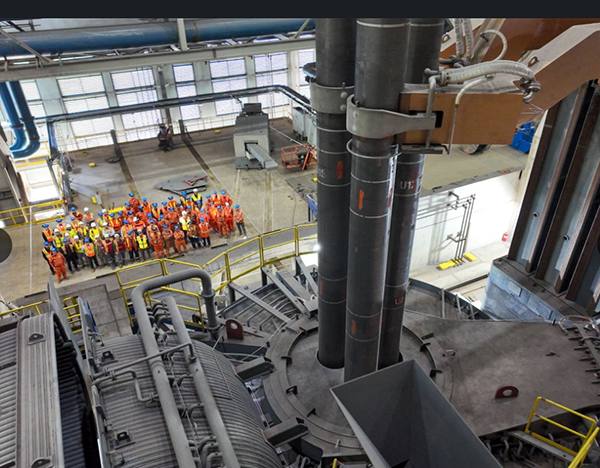
Chris Bataille, an adjunct research fellow at Columbia University’s Center on Global Energy Policy, told the Globe & Mail last August while European automakers have been paying as much as a 40 per cent premium for steel produced by EAFs, it has been mostly limited to use in that sector and not widely adopted by the building industry.
Even in Canada, ArcelorMittal’s highly-publicized flagship green steel project in Hamilton, Ont., remains at the engineering stage.
“There’s some uncertainty about how fast the transition will go,” Bataille said. “It’s just a difficult business to make a buck, to be honest.”
Looking more closely at the challenges facing green steel, in January 2026 Prof. Joseph Fournier, senior fellow at the Frontier Centre for Public Policy in Alberta, released his examination of the problems facing the transition away from coal-based furnaces.
Fournier’s work carries the somewhat provocative title, Green Steel – Viable Pathway or Costly Mirage. It questions whether the promise of green steel merely “rests primarily on demonstration projects, policy momentum and naive optimism.”
Fournier acknowledges the basic green steel argument.
“When both the hydrogen and the electricity are sourced from low emitting sources such as wind, solar PV, hydroelectric and nuclear, life-cycle emissions can fall by up to 95 per cent compared to the conventional route.”
He further explains the H2DRI, reaction process produces, “sponge iron,” which is then combined with scrap metal in modern EAFs. In some areas of Europe, EAFs achieve 70 to 100 per cent scrap-based production, “eliminating nearly all process emissions.”
Yet even so, by Fournier’s estimations, scrap steel cannot provide more than one-third of the world’s overall steel demand.
Nevertheless, even the production of one-third of all steel through scrap sounds extremely promising, particularly if projections for a steep drop in hydrogen prices produce a rapid scale-up of green hydrogen production.
But herein lays the main obstacle, according to Fournier.
“Scaling H₂-DRI+EAF to displace even a fraction of the world’s 1.9 billion tonnes of annual crude steel production would require energy inputs, mineral supply chains and grid transformations that are currently unrealistic without sustained multitrillion-dollar interventions.”
Fournier goes on to outline in detail the cost premium for producing green hydrogen, no matter the power source. He also includes an analysis of metrics called Thermal Efficiency (TE, process-level) and Energy Return on Energy Invested (ERoEI, system-level sustainability) to compare the performance of green and grey H₂-DRI + EAF steel versus by conventional BF-BOF steel production.
According to Fournier, the conclusion is clear.
“It can be expected that the whole scale adoption of green steel production will have an inflationary impact on steel prices.”
Grid stability is a critical factor as well, he continues, since EAFs need steady power supply. In Europe, expansion of hydro electrical generation is limited. Renewables like solar and wind are not constant. The result is a dependency on a “grid connected scenario” wherein “a H₂-DRI-EAF plant quickly loses its climate appeal.”
“The ultimate head wind acting to limit wide scale adoption of green steel production is the sheer capacity of new emissions-free generation required for these new facilities,” he says. “If it takes approximately 4 MWh of electricity to produce a tonne of green steel, it will require at least 8,000 TWh to replace 2 billion tonnes per year conventional steel production.”
Fournier also points other concerns, such as the geopolitical risks associated with the supply of certain key metals and ceramics from nations, such as Russia and China, required for water electrolyzers as well as hydrogen leakage issues which he says can be a “potent greenhouse gas” problem.
In conclusion, Fournier’s study exposes some stark realities concerning any transition to green steel.
“The continued dominance of the blast furnace,” he says, “is not an accident of history or policy failure. It is the predictable outcome of physics, geology and economics. Even in jurisdictions with the strongest political will and deepest subsidies, pure green operation remains economically unviable without permanent public support. But pretending that the H₂-DRI vision, as currently constituted, can displace the blast furnace at global scale by 2050 is not ambition; it is self-deception.”
John Bleasby is a freelance writer. Send comments and Climate and Construction column ideas to editor@dailycommercialnews.com.


