

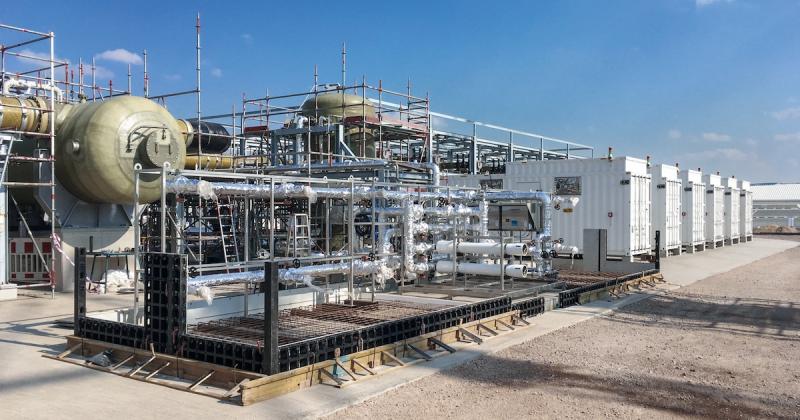
Green Hydrogen Plant
What Does It Cost to Set Up a Green Hydrogen Production Plant in India?
Setting up a 300-ton-per-year green hydrogen plant in India requires a carefully mapped investment across CapEx, OpEx, and long-term profitability. Raw material costs – primarily electricity – run between 60 to 70 percent of operating expenditure. Gross margins project between 25 and 30 percent. And capital investment spans electrolyzer procurement, renewable energy infrastructure, utilities, and compliance – all detailed in IMARC Group’s ground-up financial feasibility model built specifically for the Indian market.
If you are evaluating a green hydrogen plant setup, this is where your research should start.
India Is Not Watching the Green Hydrogen Boom – It Is Leading It:
India crossed a threshold in green hydrogen that most markets are still approaching. The policy framework is funded, the industrial demand is real, and the renewable energy cost advantage is locked in for the long term.
Here is the scale of what is happening:
• Green hydrogen was a USD 1.68 Billion global market in 2024
• It is projected to hit USD 62.39 Billion by 2033 at a 49.4% CAGR
• India has committed INR 19,744 crore under its National Green Hydrogen Mission
• The national target is 5 MMT of green hydrogen production every year by 2030
Three projects that show this is no longer theoretical:
• JSW Group’s Vijayanagar facility began producing green hydrogen for steelmaking in November 2025 – 3,800 tonnes targeted in the pilot phase
• Adani New Industries brought India’s first off-grid 5 MW green hydrogen pilot online in Kutch, Gujarat in June 2025
• OMV commissioned a EUR 25 million, 10 MW green hydrogen unit at its Schwechat refinery in Austria in April 2025
First movers are not waiting for perfect conditions. They are building while the policy support and cost advantage are at their peak.
300 Tons a Year, Fully Costed – Here Is What IMARC Actually Modelled:
The study models a 300-ton-per-year green hydrogen production plant in India powered entirely by renewable energy. Here is what goes into it:
Production approach: Water electrolysis using solar, wind, or hydro-sourced electricity – zero carbon emissions throughout the process
Three electrolyzer technologies compared:
• AEL (Alkaline Electrolysis) – proven at scale, lowest upfront cost, best for large continuous production
• PEM (Proton Exchange Membrane) – compact, fast response, produces higher purity hydrogen
• SOEC (Solid Oxide Electrolyzer Cells) – most energy efficient, best suited for high-temperature operations
Inputs the model accounts for:
• Purified water, renewable electricity, and nitrogen
Equipment covered:
• Electrolyzer unit, purification system, compression system, and storage infrastructure
Before You Sign Anything, Know Where Every Rupee of CapEx Actually Goes:
CapEx in a green hydrogen plant goes well beyond buying an electrolyzer. Here is the full picture:
Machinery and equipment accounts for 40 to 55 percent of total CapEx – the single largest cost head covering electrolyzer procurement, installation, and commissioning.
Civil and structural works cover site preparation, factory construction, and drainage. Costs vary by location and soil conditions.
Utilities setup including renewable energy tie-up, water supply, HVAC, and grid connectivity is often underbudgeted but critical for continuous operation.
Automation, compliance, and IT infrastructure round out the investment – covering SCADA systems, safety approvals, and plant management tools.
India’s CapEx advantage is clear – lower land costs, competitive construction rates, and PLI-backed domestic electrolyzer manufacturing reduce the total burden significantly compared to Western markets.
Electricity Eats 60-70% of Your Running Costs – Here Is Why That Is Great News for an India-Based Plant:
Three numbers define the operating economics of this plant:
• 60 to 70 percent of total operating cost is raw materials – dominated almost entirely by electricity consumption in the electrolysis process
• 15 to 20 percent goes to labour and manpower across plant operations, maintenance, and management
• 5 to 10 percent covers everything else – utilities, depreciation, taxes, packaging, transportation, and repairs
Since electricity drives the majority of OpEx, India’s position as one of the world’s lowest-cost renewable energy markets is a direct and permanent cost advantage. Every drop in solar or wind tariffs automatically improves your plant margin – year after year, without any operational change on your end.
Gross Margins of 25-30% – The Profitability Numbers That Make This a Bankable Project:
The model projects financials across the full income projection period:
Revenue grows steadily throughout, driven by production scale-up and strengthening demand across India’s steel, fertiliser, and refining sectors.
Gross profit margins land between 25 and 30 percent – strong for a capital-intensive industrial plant at this scale.
Net profit margins project between 10 and 20 percent, reflecting a commercially viable operation after full cost absorption.
What makes these projections credible:
• Input cost sensitivity and raw material price swings are stress-tested
• Inflation and offtake pricing variability are factored in across multiple scenarios
• Electrolyzer cost decline is based on the actual 60-plus percent reduction already achieved in the last decade
From Water to Fuel – The Step-by-Step Production Flow Inside a Green Hydrogen Plant:
Step 1 – Water pre-treatment: Incoming water goes through filtration, demineralisation, and reverse osmosis before entering the electrolyzer.
Step 2 – Electrolysis: Renewable electricity splits water into hydrogen at the cathode and oxygen at the anode.
Step 3 – Purification and drying: Raw hydrogen passes through drying and purification stages to reach industrial-grade purity.
Step 4 – Compression and storage: Hydrogen is compressed for storage, liquefied for transport, or converted into green ammonia or e-methanol.
Step 5 – Smart grid integration: Battery storage and energy forecasting tools maintain continuous production despite variable renewable supply.
INR 19,744 Crore Mission, PLI Support, VGF Funding – India’s Policy Stack That Makes This Plant Viable:
Direct financial support available:
• Viability Gap Funding for green hydrogen producers
• PLI incentives for domestic electrolyzer manufacturers
• Mandatory blending requirements proposed for fertiliser and refinery sectors
Natural resource advantage:
• Among the world’s lowest solar and wind tariffs
• Coastline enabling green ammonia export to Europe, Japan, and South Korea
Industrial demand ready from day one:
• Steel sector replacing coal-based reductants with green hydrogen
• Fertiliser industry decarbonising ammonia production
• Petroleum refineries transitioning from grey to green hydrogen
These are funded, legislated programmes with allocated budgets – not promises on paper.
Whether You Are Setting Up, Expanding, or Entering – This Cost Model Is Built for Your Stage:
• Project developers & EPC contractors – Build realistic budgets and avoid CapEx underestimation that stalls projects at the financing stage
• Investors & PE firms – Get ground-up profitability projections before committing capital
• Industrial buyers in steel, refining and chemicals – Understand the true cost of switching from grey to green hydrogen
• First-time entrants – Walk in with a complete techno-commercial blueprint
• Policy makers & development finance institutions – Use plant-level data when designing VGF structures and incentive frameworks
From Cost Model to Committed Investment – This Is Where Every Plant Decision Starts:
Green hydrogen is not a speculative bet anymore. It is a commercially viable, policy-supported, and rapidly scaling industry – and India is at the centre of it.
IMARC Group’s feasibility case study gives you CapEx mapped by investment head, OpEx broken down by cost driver, and profitability stress-tested against real-world variables – all for a 300-ton-per-year green hydrogen plant in India.
Contact Us:
IMARC Group
134 N 4th St. Brooklyn, NY 11249, USA
Email: sales@imarcgroup.com
Tel No: (D) +91 120 433 0800
United States: (+1-201-971-6302)
This release was published on openPR.


