

India’s NeuEN Green Energy (NGE), a 50:50 joint venture between government-owned Bharat Petroleum Corporation Ltd (BPCL) and Singapore-based energy solutions company Sembcorp Industries Ltd, has offered the lowest-ever price of Rs 279 per kg for the supply of green hydrogen to Numaligarh Refinery in Assam. The Gurugram-based renewable energy solutions provider emerged as the winner of Numaligarh Refinery Ltd’s 10,000 metric tonnes per annum (MTPA) tender for a green hydrogen generation unit on a build-own-operate basis.
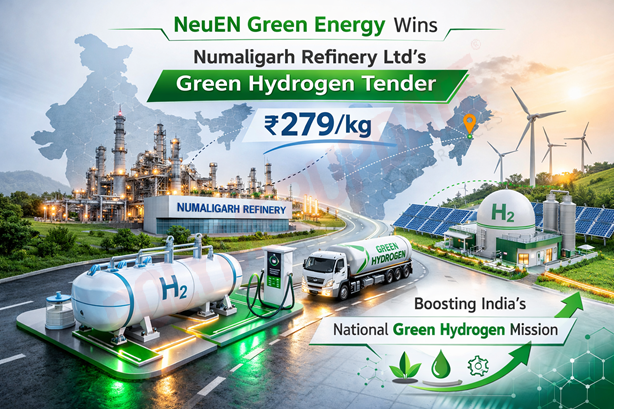 Union Renewable Energy Minister Pralhad Joshi announced the winning bid on Wednesday. Reports said nine bidders participated in the tender but did not disclose the names of the other participants. Numaligarh Refinery Ltd is a company majority-owned by state-run Oil India Ltd (OIL) in the northeastern state of Assam.
The tender guidelines outline the scope of work, including design, detailed engineering, and construction of all civil, structural, mechanical, electrical, and instrumentation facilities. They also cover testing, commissioning, and the supply of green hydrogen. In addition, the scope includes providing operations and maintenance services for 25 years.
Supply conditions
Gaseous green hydrogen is required to be produced either through water electrolysis powered by renewable energy or through biomass processing. NGE must independently procure biomass and ensure a continuous supply of compressed biogas and syngas feedstock to meet the specified green hydrogen output requirements. The tender was initially floated on August 23, 2024, and was re-tendered on May 23, 2025, to find a suitable and competitive bidder.
As per the tender conditions, the bidder must source renewable energy to produce green hydrogen from its own projects, a third-party renewable energy producer, or a power exchange. The company must also arrange for the import of power to the operator’s production site. The project scope of work also includes land procurement for developing the operator’s production site.
Increasing government’s focus
Indian government organisations have intensified their focus on green hydrogen, gradually transitioning toward this environment-friendly energy source. In January this year, the Agency for New and Renewable Energy Research and Technology invited bids for the development of pilot projects to produce green hydrogen from biomass. In the same month, the Biotechnology Industry Research Assistance Council invited proposals for pilot projects to produce green hydrogen using biomass or other innovative technologies.
The Ministry of New and Renewable Energy released Rs 67.95 crore (US$ 7.8 million) as the first tranche of central financial assistance to four hydrogen valley innovation clusters under the National Green Hydrogen Mission. A hydrogen valley is a specific geographic region where hydrogen is used across sectors such as industry, energy, and mobility. Meanwhile, India’s Union Finance Minister Nirmala Sitharaman doubled the revised outlay to Rs 600 crore (US$ 65.44 million) for the financial year 2026–27, up from a revised outlay of Rs 300 crore (US$ 32.72 million) in the previous year.
India’s green hydrogen mission
India has embarked on an ambitious clean-energy pathway through the National Green Hydrogen Mission, a flagship initiative aimed at transforming the country into a global hub for the production, usage, and export of green hydrogen. The mission represents a strategic shift toward deep decarbonisation of industry, transport, and energy systems while strengthening energy security and creating new manufacturing ecosystems. Announced by the Government of India and formally approved in 2023, the mission places green hydrogen at the center of India’s long-term climate and industrial policy framework.
Green hydrogen is produced by splitting water into hydrogen and oxygen using electricity generated from renewable sources such as solar and wind. Unlike grey or blue hydrogen — which rely on fossil fuels — green hydrogen is virtually carbon-free at the point of production. It is widely seen as a critical fuel for sectors that are difficult to electrify directly, including, steel and cement manufacturing, refining and fertilizers, heavy transport and shipping, long-duration energy storage and grid balancing for renewable power. For a fast-growing economy like India, green hydrogen offers a pathway to reduce dependence on imported fossil fuels while meeting climate commitments.
The National Green Hydrogen Mission sets out clear production and capacity goals for the early 2030s. Key targets include annual green hydrogen production capacity of about 5 million metric tonnes, creation of large renewable energy capacity dedicated to hydrogen production, significant reduction in fossil fuel imports, major cuts in carbon emissions from hard-to-abate sectors, and development of export capabilities in hydrogen and its derivatives (such as green ammonia). The programme is backed by multi-billion-dollar public financial support, designed to crowd in private investment and accelerate commercialization.
DILIP KUMAR JHA
Editor
dilip.jha@polymerupdate.com


