

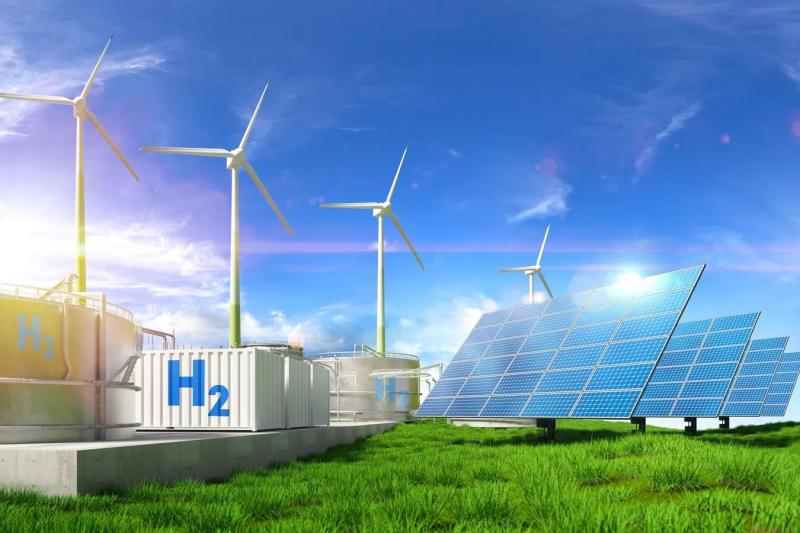
Green Hydrogen Renewable Energy
The Green Hydrogen Renewable Energy Market is currently orchestrating a systemic overhaul of the global industrial economy, serving as the critical “missing link” in the net-zero equation. For decades, hydrogen was a niche industrial gas produced from fossil fuels, known as grey hydrogen. Today, the market involves the production of hydrogen via water electrolysis powered exclusively by renewable energy sources like wind and solar. This transition is not merely about energy generation but about decarbonizing “hard-to-abate” sectors where electrification is physically impossible, such as steel manufacturing, chemical production, and long-haul maritime shipping. As of 2026, the sector has graduated from pilot projects to gigawatt-scale industrial deployments, driven by a convergence of plummeting renewable energy costs, government subsidy wars, and the geopolitical imperative for energy independence.
Recent Developments
January 2026 – The Trans-Oceanic Ammonia Corridor: A consortium of European and Australian energy giants officially commissioned the first dedicated “Green Ammonia Maritime Corridor.” This trade route utilizes massive solar arrays in the Australian outback to produce green hydrogen, convert it to ammonia, and ship it to the Port of Rotterdam, validating the feasibility of intercontinental renewable energy trade.
October 2025 – Green Steel Industrial Switch: A leading global steel manufacturer successfully fired up its first direct reduction iron (DRI) plant running on 100 percent green hydrogen. This milestone marked the first commercial production of carbon-neutral steel at scale, signaling to the automotive industry that the supply chain for green metal is now operational.
July 2025 – The Electrolyzer Efficiency Record: A top-tier clean tech research institute unveiled a next-generation Solid Oxide Electrolyzer Cell (SOEC) capable of operating at 90 percent electrical efficiency when integrated with industrial waste heat. This thermal integration breakthrough significantly lowers the Levelized Cost of Hydrogen (LCOH), making it cost-competitive with blue hydrogen in specific industrial clusters.
Get Sample: https://marketresearchcorridor.com/request-sample/15990/
Strategic Market Analysis: Dynamics and Future Trends
The innovation trajectory in this sector is pivoting from Alkaline to Next-Gen Electrolysis. While traditional alkaline electrolyzers are reliable, the market is aggressively adopting Proton Exchange Membrane (PEM) and Solid Oxide technologies. These newer systems offer faster ramp-up times, allowing them to pair perfectly with the intermittent nature of wind and solar power, absorbing excess grid energy during peak production hours.
Operationally, there is a decisive move toward the “Hydrogen Valley” model. Instead of building isolated production plants, stakeholders are developing integrated ecosystems where production, storage, and consumption are co-located. By placing the hydrogen plant directly next to the steel mill or chemical refinery, companies eliminate the expensive and technically difficult challenge of transporting low-density hydrogen gas over long distances.
Looking forward, the future outlook is defined by the Derivatives Economy. The market recognizes that transporting pure hydrogen is inefficient. Therefore, the strategic focus is shifting toward “Hydrogen Carriers” like Green Ammonia and Green Methanol. These liquid derivatives are easier to ship using existing infrastructure and will serve as the primary global currency of renewable energy trade by 2030.
SWOT Analysis: Strategic Evaluation of the Market Ecosystem
Strengths
The primary strength of Green Hydrogen is its Versatility. It is the only energy vector that can seamlessly bridge the gap between the electricity grid and the chemical industry. It can store energy for months, unlike batteries which discharge in hours, providing critical seasonal storage resilience. Furthermore, its production creates no carbon emissions, offering the only true path to zero for industries that require high-grade heat and chemical feedstocks.
Weaknesses
A significant weakness is the Round-Trip Efficiency Loss. Converting electricity to hydrogen and then back to energy or using it in a fuel cell results in energy losses of up to 60 percent. This physics-based limitation means hydrogen will always be more expensive than direct electrification where batteries are a viable option. Additionally, the High CAPEX of electrolyzers and the infrastructure required for storage and transport remain a barrier to financial viability without subsidies.
Opportunities
A massive opportunity exists in the Fertilizer Industry. The production of ammonia for fertilizer currently consumes huge amounts of natural gas. Replacing this with green ammonia is the “low-hanging fruit” for the industry, creating an immediate, massive market that does not require new end-use technology. There is also significant potential in Heavy-Duty Transport, where hydrogen fuel cells offer range and refueling times for trucks and trains that battery-electric equivalents cannot yet match.
Threats
The primary threat is the Cost Gap with Fossil Fuels. Despite cost reductions, green hydrogen remains more expensive than grey hydrogen produced from natural gas. If policy subsidies like the U.S. Inflation Reduction Act or the EU Hydrogen Bank are repealed or watered down, many projects could become financially insolvent. Supply Chain Constraints for critical materials like iridium and platinum used in electrolyzers also pose a risk to scaling up manufacturing capacity.
Drivers, Restraints, Challenges, and Opportunities Analysis
Market Driver – Energy Sovereignty: The energy crisis following geopolitical conflicts has made imported natural gas a liability. Governments view green hydrogen as a way to convert domestic wind and sun into a storable fuel, reducing reliance on foreign energy autocracies.
Market Driver – Decarbonization Mandates: Strict carbon pricing and border adjustment mechanisms (like the EU CBAM) are effectively penalizing high-carbon industrial products. This forces heavy industries to switch to green hydrogen to remain competitive in global export markets.
Market Restraint – Infrastructure Deficit: You cannot simply pump hydrogen into existing natural gas pipelines without modification due to embrittlement risks. The lack of dedicated hydrogen pipelines and refueling stations is a bottleneck that restricts the downstream adoption of the fuel.
Key Challenge – The “Cannibalization” of Renewables: Producing green hydrogen requires massive amounts of renewable electricity. There is a concern that diverting wind and solar power to make hydrogen could slow down the decarbonization of the main power grid, creating a conflict over renewable resources.
Deep-Dive Market Segmentation
By Technology
Alkaline Electrolyzer
Proton Exchange Membrane (PEM) Electrolyzer
Solid Oxide Electrolyzer Cell (SOEC)
Anion Exchange Membrane (AEM)
By Application
Power Generation (Peaker plants, Energy storage)
Transportation (Fuel Cell Vehicles, Maritime, Aviation)
Industrial Feedstock (Green Ammonia, Green Methanol, Steel)
Building Heating (Blending)
By Distribution Channel
Pipeline Transportation
Liquid Hydrogen Tankers
Chemical Carriers (Ammonia/LOHC)
By End User
Chemical and Petrochemical Industry
Iron and Steel Industry
Mobility and Transport
Utilities and Power Providers
Regional Market Landscape
Europe: This region acts as the Global Policy Pioneer. Driven by the REPowerEU plan and the European Hydrogen Bank, Europe has the most mature regulatory framework and is actively building the “Hydrogen Backbone” pipeline network. The region is the primary demand center, seeking to import hydrogen to fuel its heavy industries.
Asia-Pacific: This is the Volume and Supply Leader. China is the world’s largest producer of electrolyzers and is deploying massive domestic projects. Australia is positioning itself as the “Saudi Arabia of Green Hydrogen,” leveraging vast land and solar resources to produce export-grade ammonia for the Asian market.
North America: The market here is shaped by Subsidies. The production tax credits from the Inflation Reduction Act have made the U.S. one of the cheapest places in the world to produce green hydrogen, attracting massive foreign investment into projects along the Gulf Coast.
Competitive Landscape
Electrolyzer Manufacturers:
Nel ASA (Alkaline/PEM leader), ITM Power, ThyssenKrupp Nucera, Plug Power (Vertical integration), Siemens Energy, Bloom Energy (Solid Oxide focus), Cummins (Accelera).
Industrial Gas Giants:
Linde, Air Liquide, Air Products (Major project developers).
Energy Majors:
BP, Shell, TotalEnergies, Iberdrola, Enel Green Power.
Click Here, Download a Free Sample Copy of this Market: https://marketresearchcorridor.com/request-sample/15990/
Strategic Insights
The “Electron vs. Molecule” Rule: The strategic consensus is clarifying. If you can plug it in, use a battery (cars, heat pumps). If you can’t plug it in, use green hydrogen (ships, blast furnaces). Companies that align their strategy with this physics-based reality are winning; those trying to force hydrogen into passenger cars are losing ground.
Bankability via Offtake: The biggest hurdle for project developers is not technology, but finance. Banks will not fund a gigawatt-scale plant without a signed long-term contract from a buyer. The strategic focus is on securing “Offtake Agreements” with steelmakers or chemical plants to reach Final Investment Decision (FID).
Retrofitting over Building: Rather than building new industrial clusters from scratch, the smartest players are retrofitting existing grey hydrogen facilities. By replacing the steam methane reformer with an electrolyzer at an existing ammonia plant, developers can utilize existing storage and distribution infrastructure, drastically reducing initial capital outlay.
Contact Us:
Avinash Jain
Market Research Corridor
Phone : +91 750 750 2731
Email: Sales@marketresearchcorridor.com
Address: Market Research Corridor, B 502, Nisarg Pooja, Wakad, Pune, 411057, India
About Us:
Market Research Corridor is a global market research and management consulting firm serving businesses, non-profits, universities and government agencies. Our goal is to work with organizations to achieve continuous strategic improvement and achieve growth goals. Our industry research reports are designed to provide quantifiable information combined with key industry insights. We aim to provide our clients with the data they need to ensure sustainable organizational development.
This release was published on openPR.


