

Producing clean hydrogen from water is often compared to storing renewable energy in chemical form, but improving the efficiency of that process remains a scientific challenge. Researchers at Tohoku University have now developed a catalyst design that helps hydrogen form more smoothly under alkaline conditions, a key step toward practical green hydrogen production.
Hydrogen generation in alkaline water electrolysis depends on the hydrogen evolution reaction (HER). In anion exchange membrane water electrolysis (AEMWE), this reaction involves two tightly connected steps: splitting water molecules and forming hydrogen gas. If either step slows down, overall performance suffers.
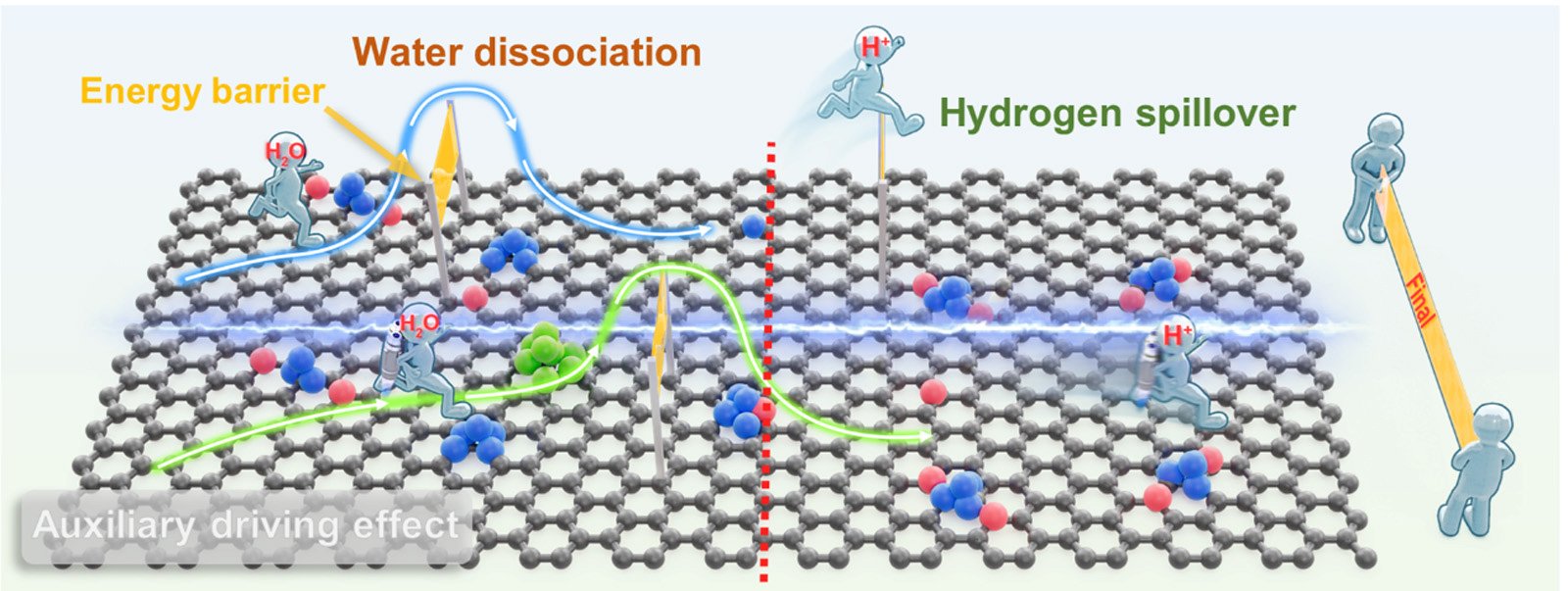
Many existing catalysts improve only one of these steps. Only a partial increase in efficiency can have a detrimental impact on overall output. It is similar to an assembly line where one worker moves faster but the next cannot keep up. To address this imbalance, the research team focused on coordinating both steps at the same time.
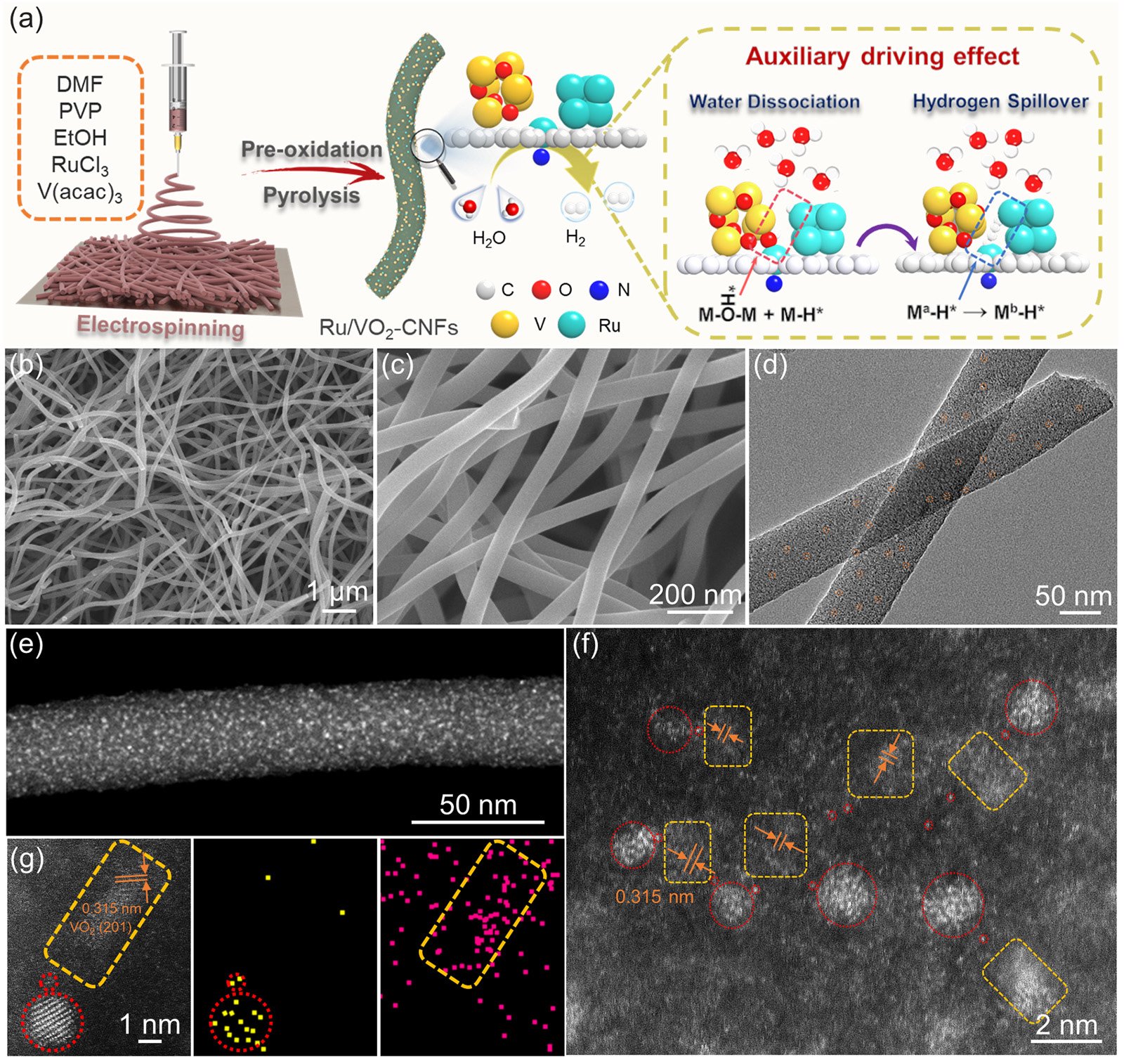
The researchers proposed an auxiliary-driving strategy that combines ruthenium (Ru) with vanadium dioxide (VO₂). By surrounding Ru active sites with VO₂, the catalyst is designed to consecutively optimize both the water dissociation step (Volmer step) and the hydrogen formation step (Heyrovsky step).
At the interface between Ru and VO₂, the formation of V-O-Ru conjugated π-bonds dynamically adjusts the electronic structure of the active sites. This promotes faster water dissociation. At the same time, a reversible hydrogen spillover process helps regulate hydrogen adsorption, bringing the catalyst closer to optimal reaction conditions predicted by microkinetic models.
Under identical testing conditions, the new catalyst showed higher hydrogen evolution activity than conventional Ru/C and Pt/C catalysts. It achieved an overpotential of 12 mV at 10 mA cm⁻² and a turnover frequency of 12.2 s⁻¹, indicating efficient hydrogen production with low energy loss.
The team also evaluated the catalyst in a working AEMWE device. Using distribution of relaxation time (DRT) analysis, they confirmed that the improved reaction kinetics observed in laboratory tests translated to device-level performance.
“This auxiliary-driving concept allows us to coordinate multiple reaction steps rather than optimizing them separately,” said Yizhou Zhang, associate professor at Tohoku University’s Advanced Institute for Materials Research. “By engineering the interface between Ru and VO₂, we can improve overall reaction kinetics in alkaline hydrogen evolution.”
More efficient and durable electrolyzers can reduce the electricity required to produce hydrogen and extend system lifetime. Lowering the cost of green hydrogen could support its broader use in sectors such as steel production, chemical manufacturing, shipping, and large-scale energy storage. The researchers plan to further refine the interfacial structure and explore whether the auxiliary-driving strategy can be applied to other catalytic systems.
All the key experimental and computational data are also uploaded to the Digital Catalysis Platform, the largest catalysis database to date developed by the Hao Li Lab.

- Publication Details:
Title: Stepwise Acceleration of Water Dissociation and Hydrogen Spillover for Enhanced Overall Alkaline Hydrogen Evolution
Authors: Tingyu Lu, Jing Li, Caikang Wang, Heng Liu, Songbo Ye, Xue Jia, Linda Zhang, Di Zhang, Dongmei Sun, Yanhui Gu, Qiang Wang, Bo Da, Li Wei, Yizhou Zhang, Hao Li, and Yawen Tang
Journal: ACS catalysis
DOI: 10.1021/acscatal.5c08576


