

Support CleanTechnica’s work through a Substack subscription or on Stripe.
Or support our Kickstarter campaign!

Europe’s gas crisis in 2022 is often described as a supply shock driven by geopolitics, but that framing misses the core lesson. The crisis was not caused by import dependence in general, nor by shortages of industrial feedstocks. It was caused by reliance on an imported energy carrier that sat at the margin of electricity and heat markets and therefore set prices across the economy. Natural gas did not need to be the dominant energy source to trigger the crisis. It only needed to be marginal. Once gas prices spiked, electricity prices followed, household heating costs surged, industrial energy bills rose in parallel, and governments were forced into fiscal intervention measured in hundreds of billions of euros. Inflation accelerated and monetary policy tightened. None of this occurred because Europe imported iron, ammonia, or other feedstocks. It occurred because Europe imported gas for energy.
Energy prices behave differently from feedstock prices because energy is a system input rather than a sectoral input. Electricity and heat underpin almost every economic activity simultaneously, and energy prices propagate through wholesale markets, retail tariffs, industrial contracts, transport costs, and consumer prices with little friction. Feedstocks do not have this property. If the price of imported iron units rises, steel producers feel the impact and downstream customers may see higher prices, but the shock does not reset electricity markets or household bills. If ammonia prices increase, fertilizer producers and agriculture absorb the change, but the economy does not experience a generalized price spike. Energy carriers used for power and heat occupy a unique position at the top of the cost stack, which is why their volatility becomes macroeconomic.
The events of 2022 demonstrated this distinction with unusual clarity. Gas did not disappear from Europe. Physical shortages were managed through demand reduction, storage drawdowns, and alternative supplies. The damage came from prices. Gas prices increased by multiples, and because gas was marginal in electricity generation, power prices increased by similar magnitudes even in systems where gas provided a minority share of total generation. The result was a price shock that propagated far beyond the gas sector. Governments responded with price caps, subsidies, and emergency market interventions to prevent social and industrial collapse. These responses were not optional. They were required because energy prices affect everyone at once.
This is the context in which hydrogen for energy must be evaluated. When hydrogen is proposed as a fuel for power generation, industrial heat, or backup capacity, it is being positioned to play the same marginal role that gas played. Even if hydrogen supplies only a small share of total energy, if it is required to meet peak demand or provide dispatchable capacity, its price will influence clearing prices across the system. If hydrogen is expensive or volatile, electricity prices will reflect that, regardless of how much hydrogen is actually consumed. This is not a transitional issue that resolves with scale. It is a structural property of marginal pricing in energy markets.
Proponents often argue that green hydrogen changes this risk profile because it is low carbon and sourced from friendly suppliers. That argument confuses emissions with economics. Green hydrogen remains dominated by electricity input costs, conversion losses, transport costs, and infrastructure charges. Germany’s own planning assumes that 50% to 70% of hydrogen demand in 2030 will be met through imports, amounting to roughly 45 to 90 TWh. Imported hydrogen or hydrogen derivatives will be exposed to global electricity prices, shipping constraints, conversion costs, and policy risk in exporting countries. These are not stable inputs. They are layered costs that introduce volatility, not resilience.
By contrast, domestic renewable electricity has a different price structure. Wind and solar are capital intensive, but once built their marginal costs are low and predictable. They do not reprice the economy when global fuel markets move. Storage and demand flexibility add further insulation by reducing reliance on marginal fuels during peak periods. Electrification weakens the price transmission channel that turned gas price spikes into economy wide crises. Hydrogen for energy strengthens that channel by introducing another imported fuel into the marginal position.
Industrial feedstocks do not pose the same strategic risk because they cannot reprice the economy. Green iron, ammonia, and methanol can be imported in large volumes without becoming macroeconomic levers. Their price volatility is absorbed within specific value chains. Firms manage that risk through contracts, inventories, supplier diversification, and product pricing. Governments are rarely compelled to intervene to stabilize feedstock prices because feedstock shocks do not threaten social stability or basic services in the short term. Even when feedstock prices rise sharply, the effects are uneven and contained.
The difference becomes clearer when considering substitutability and buffering. Feedstocks can be stockpiled for weeks or months. Production schedules can be adjusted. Alternative suppliers can be sought. Energy carriers used for power and heat lack this flexibility. Electricity must be balanced in near real time. Hydrogen used as an energy carrier requires continuous supply to maintain system stability. If hydrogen prices spike or supplies tighten, there are few rapid substitutes once hydrogen has been embedded in the energy system. This is why energy price shocks force governments into emergency action, while feedstock price shocks rarely do.
Carbon border adjustment mechanisms are often cited as a counterargument, but they do not address this distinction. CBAM reduces the advantage of high carbon imports into the EU market by applying a carbon cost aligned with the EU ETS. It does not lower domestic energy costs, and it does not protect EU exporters competing in markets outside the EU. If German industry relies on hydrogen based energy pathways with high input costs, CBAM does not make those products competitive globally. It only penalizes competitors who fail to decarbonize, and competitors can respond by electrifying and lowering their embedded emissions. CBAM is a compliance tool, not a cost equalizer.
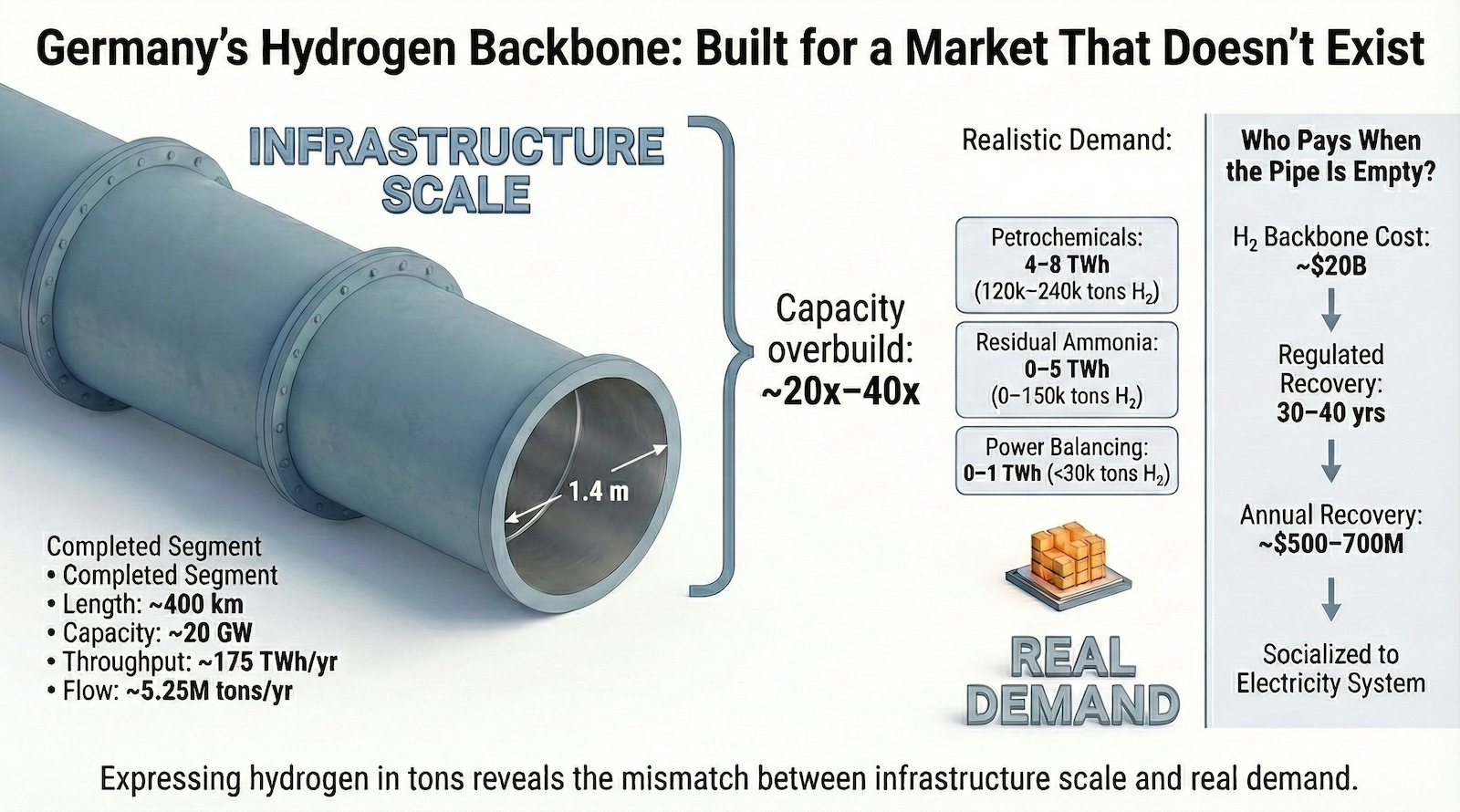
This is where hydrogen pipelines like Germany’s newly pressurized backbone without customers or suppliers—a pipeline from nowhere to nowhere—become problematic from a strategic perspective. Building hydrogen pipelines before cheap and abundant hydrogen exists—and it never will exist—encourages industry and policymakers to assume that hydrogen will be available at acceptable prices, and it embeds hydrogen into regulated infrastructure with political protection. Once hydrogen becomes part of the regulated energy system, price volatility becomes harder to contain because too many services depend on it. The state then faces pressure to subsidize hydrogen prices or shield consumers and industry from shocks, repeating the dynamic seen with gas.
Green ammonia, methanol, and iron are fundamentally different from hydrogen used as an energy carrier because they enter the economy as industrial materials rather than price-setting fuels. Their prices affect specific value chains, not the entire energy system. If the cost of green iron rises, it affects steel producers and downstream manufacturers, but it does not reprice electricity, heating, or transport across society. This containment is what makes these imports strategically manageable. They remain commercial risks borne by firms, not macroeconomic risks borne by states.
These materials also align closely with Europe’s existing industrial structure. Green iron would feed directly into Europe’s steel sector, particularly producers of high-grade flat steel, specialty alloys, and engineered steels used in automotive manufacturing, rail, construction systems, wind turbines, and industrial machinery. Europe does not compete on bulk commodity steel. It competes on quality, tolerances, performance, and integration into complex products. Importing low-emissions iron units allows European steelmakers to decarbonize upstream inputs while preserving their focus on high-margin finishing, alloying, rolling, and fabrication, which is where skills intensity and value creation are highest.
Green ammonia and methanol fit the same pattern in chemicals and downstream manufacturing. Ammonia is a core input to fertilizers, explosives, and chemical intermediates. Methanol is a platform chemical used in plastics, resins, solvents, coatings, and synthetic materials. European chemical firms are global leaders in formulation chemistry, process optimization, specialty products, and integrated chemical systems. They generate value not by producing the cheapest bulk molecules, but by transforming them into tailored, high-performance products. Importing low-emissions ammonia and methanol supports decarbonization without forcing European producers to compete on primary energy costs where they are structurally disadvantaged.
Green methanol, specifically biomethanol, is highly likely to become an energy carrier, but only for longer haul shipping, a much smaller energy segment than ground transportation, more suitable for bunkering arbitrage and highly likely to be supplemented with hybrid battery electric maritime power systems.
Critically, these feedstocks are compatible with buffering and risk management at the firm level. Iron units, ammonia, and methanol can be stockpiled for weeks or months, contracted long term, and sourced from multiple suppliers. Firms can manage price volatility through inventories and commercial hedging. Disruptions affect production schedules and margins, but they do not force governments into emergency interventions. This is exactly how advanced industrial economies have always managed raw material dependence, and it remains a viable model in a decarbonized context.
Importing these green intermediates also preserves high-quality employment. Steel finishing plants, chemical complexes, automotive factories, machinery producers, and advanced manufacturing clusters employ large numbers of highly skilled workers at wages well above national averages. These jobs depend on engineering expertise, process control, digital systems, and complex supply chain integration. Forcing these industries to internalize energy-intensive primary production using high-cost electricity would compress margins and ultimately threaten employment. Importing green feedstocks instead protects profitability while maintaining domestic value-added activity.
The broader strategic benefit is that this approach decouples industrial decarbonization from domestic electricity price disadvantages. Regions with abundant low-cost renewables can specialize in energy-intensive primary production. Europe specializes in transformation, precision manufacturing, and systems integration. That division of labor lowers total system cost, accelerates emissions reductions, and keeps European industry competitive. It also ensures that exposure to global markets remains proportional and manageable, rather than systemic.
In this context, importing green ammonia, methanol, and iron is not a concession or a retreat. It is an industrial strategy that preserves margins, sustains good-paying jobs, and limits strategic vulnerability. By treating these materials as tradable inputs rather than as energy carriers, Europe can decarbonize its industrial base without recreating the price and security risks that accompanied dependence on imported fuels.
Electrification offers a different trajectory than imported hydrogen. By shifting energy demand toward domestically produced electricity with low marginal costs, electrification reduces exposure to imported price setters. It flattens price curves over time and reduces the scale of fiscal intervention required during external shocks. This is not an abstract benefit. During the gas crisis, countries with higher shares of domestic renewables experienced lower wholesale price volatility than those more exposed to gas. Electrification is therefore not just an efficiency or climate strategy. It is a price stability strategy.
The implications for industrial policy are significant. Industries anchored to stable electricity prices are better positioned to compete globally than those tied to volatile imported fuels. This is already visible in electricity price comparisons. EU industrial electricity prices have hovered around €0.15 to €0.20 per kWh excluding taxes, while comparable prices in the US and China have been closer to $0.07 to $0.09 per kWh. This is a well known problem, and Germany, for example, is responding with €0.06 per kWh industrial energy pricing. Building industrial decarbonization pathways on top of this disadvantage using hydrogen compounds the problem rather than solving it. Direct electrification, combined with grid expansion and renewable buildout, reduces the disadvantage over time.
Germany can act on this insight without abandoning hydrogen entirely. Hydrogen can and should be constrained to roles where it does not become a price setter, such as chemical feedstocks and specific industrial processes where alternatives are limited. What must be avoided is allowing hydrogen to become a marginal energy carrier for power or heat. That requires explicit policy choices. Infrastructure investment should prioritize transmission, distribution grids, storage, and demand flexibility. Success metrics should focus on price stability, delivered electricity capacity, and export competitiveness, not hydrogen volumes moved through pipelines.
The real lesson of 2022 is not that Europe chose the wrong supplier. It is that Europe allowed an imported fuel to set energy prices across the economy. Replacing gas with hydrogen in that role would repeat the mistake with a different molecule. Strategic vulnerability arises when price setting power is imported. Limiting hydrogen to feedstock roles and accelerating electrification removes that vulnerability at its root, which is why this distinction matters far more than debates about color labels or supplier geography.
Support CleanTechnica via Kickstarter

Sign up for CleanTechnica’s Weekly Substack for Zach and Scott’s in-depth analyses and high level summaries, sign up for our daily newsletter, and follow us on Google News!
Have a tip for CleanTechnica? Want to advertise? Want to suggest a guest for our CleanTech Talk podcast? Contact us here.
Sign up for our daily newsletter for 15 new cleantech stories a day. Or sign up for our weekly one on top stories of the week if daily is too frequent.
CleanTechnica uses affiliate links. See our policy here.
CleanTechnica’s Comment Policy


