

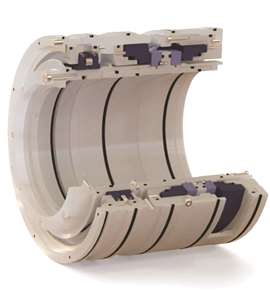
 Flowserve said its Aquapac seal represents an innovation for hydrogen turbomachinery.
As the hydrogen economy gains momentum, industries worldwide are under increasing pressure to accelerate the shift toward cleaner, more sustainable energy systems. At the core of this transformation lies a critical challenge to develop technologies that not only deliver performance and reliability but also meet rigorous decarbonization and emissions-reduction targets.
Clean hydrogen, particularly green hydrogen produced from renewable energy, is emerging as a cornerstone of the global energy transition. Yet realizing its full potential, demands innovation at every step of the value chain especially in compression and transport, where purity, safety, and zero-emission operation are non-negotiable.
In close collaboration with one of the leading compressor manufacturers, Flowserve’s engineering team has developed a water-lubricated mechanical seal purpose-built for oil-free screw compressors used in green hydrogen applications. This novel solution eliminates the need for oil or inert-gas barriers by using pure water as the sealing medium enabling truly clean, zero-emission hydrogen compression. Beyond improving operational efficiency, this technology represents a step change toward a safer, more sustainable hydrogen infrastructure aligned with global climate goals.
The Need for a New Approach
Green hydrogen production relies on electrolyzers powered by renewable energy to generate ultra-pure hydrogen. Once produced, the gas must be compressed, purified, and transported. These processes demand exceptional reliability and cleanliness. Conventional sealing technologies for turbomachinery often depend on oil or inert-gas barriers, which can risk contamination or introduce emissions.
To address these limitations, Flowserve partnered with a compressor manufacturer to develop a zero-emission, water-lubricated mechanical seal that uses the same high-purity water employed in the electrolyzer process itself.
The use of dry screw compressors is particularly well-suited for hydrogen applications due to hydrogen’s low molecular weight and unique thermodynamic behavior. Unlike turbo compressors which rely on high flow rates and often struggle with hydrogen’s low density, screw compressors are positive-displacement machines, compressing gas by reducing volume between meshing rotors. This allows for higher pressure ratios per casing and efficient handling of low-density gases, particularly in small- to mid-scale hydrogen installations.
In addition, screw compressors provide operational flexibility, ideal for variable loads tied to intermittent renewable energy sources, according to Flowserve. Compared to reciprocating compressors, they feature fewer moving parts, no valves, and reduced wear to deliver lower maintenance, improved reliability, and reduced operating costs (OPEX).
“Hydrogen is one of the most demanding gases to compress. It’s light, small, and prone to leakage. Screw compressors, when paired with the right sealing solution, offer a compact, efficient, and low-maintenance path to clean compression,” said Joe Barker, Engineering Specialist at Flowserve. “Our goal was to make oil-free hydrogen compression not just possible, but practical for long-term operation.”
Engineering a High-Speed, Water-Lubricated Seal
Designing a mechanical seal capable of reliable operation in oil-free hydrogen service at speeds exceeding 100 m/s presented a formidable challenge. Conventional designs typically operate below 25 m/s and depend on lubricating oils or inert gases. Developing a high-speed, water-lubricated seal for hydrogen demanded a complete rethinking of materials, design geometries, and testing protocols.
At Flowserve, we leverage decades of expertise in sealing technology, rotating equipment, and fluid dynamics to tackle such challenges. Our engineers developed a system that meets the demanding conditions of hydrogen compression while ensuring zero emissions, uncompromised gas purity, and long-term reliability.
Key performance enablers include:
- Zero emissions and hydrogen purity: No oil or inert-gas contamination; hydrogen remains ultra-pure.
- High-speed operation: Reliable sealing at extreme peripheral speeds with minimal wear.
- Thermal management: Optimized internal geometries to effectively dissipate heat.
- Leakage control: Engineered for back-pressure tightness and minimal water loss.
- System integration: Custom-fit designs for diverse compressor configurations and process parameters.
“Hydrogen compression at these speeds, without oil or inert gas, is no small feat. But it’s exactly the kind of challenge our engineering teams are built to overcome,” added Barker. “This seal demonstrates how close collaboration with customers can lead to truly industry-leading innovation.”
From Laboratory to Proven Reliability
Following design development, Flowserve conducted an extensive testing program to verify performance and reliability under real-world conditions. A total of 45 tests were performed under varied operating parameters, resulting in 700+ testing hours, 170,000 data samples, and over 5 million logged points. Tests simulated field scenarios including:
- Continuous and variable-speed operation
- Temperature and pressure upsets
- Dry turning during assembly
- Slow roll and emergency trip events
The results validated the seal’s integrity, confirming no hydrogen leakage and stable operation at speeds up to 12,500 RPM. The performance results fully qualified the new seal design, providing OEMs and operators with a proven, zero-emission solution for hydrogen compression.
Leveraging Data Analytics for Next-Generation Design
To complement experimental validation, the team developed a data-analytics framework to extract insights from high-resolution test datasets. Using multivariate correlation analysis and regression modeling, engineers identified key parameters influencing performance such as chamber pressure, rotational speed, and barrier-fluid flow.
“With the vast amount of test and operational data available in turbomachinery systems, data analytics and machine-learning techniques are transforming how we design, test, and optimize mechanical systems,” said Abubakar Rashid, Senior R&D Engineer at Flowserve. “By applying predictive modeling, we can understand complex interdependencies, improve reliability, and accelerate development cycles. As we advance, our future seal-performance models will incorporate machine-learning frameworks and expanded datasets to enhance robustness across geometries and operating regimes, including cross-validation with field data.”
A Step Forward for the Hydrogen Economy
“The Aquapac seal represents more than a sealing solution, it is a technological innovation in hydrogen-ready turbomachinery. By eliminating oil and inert gases and adopting pure water as a sealing medium, this system delivers truly clean, emission-free compression,” said Abubakar Rashid. “It enables compressor OEMs to design fully oil-free systems with greater flexibility and gives operators a reliable, maintenance-efficient, and compliant solution, all while reducing total cost of ownership.”
Author: Abubakar Rashid
 Abubakar Rashid
Abubakar Rashid is a Senior R&D Engineer for Turbomachinery & Systems at Flowserve Corporation based in Kalamazoo, MI. He completed his M.S. in Mechanical Engineering from Texas A&M University & is an alum of famous Turbomachinery Lab. Abubakar actively participates in industry standard organizations and is active member of Hydraulic Institute Standard committees.
Co-Author: Joe Barker
Joe Barker (PE) is an Engineering Specialist at Flowserve Corporation based in Kalamazoo, MI. He graduated from Western Michigan University with a B.S. in Mechanical Engineering. He has over 20 years of experience working with mechanical seal design, sealing systems, and fluid handling equipment. Mr. Barker is an active member of the API692 2nd edition Task Force.
 Joe Barker


