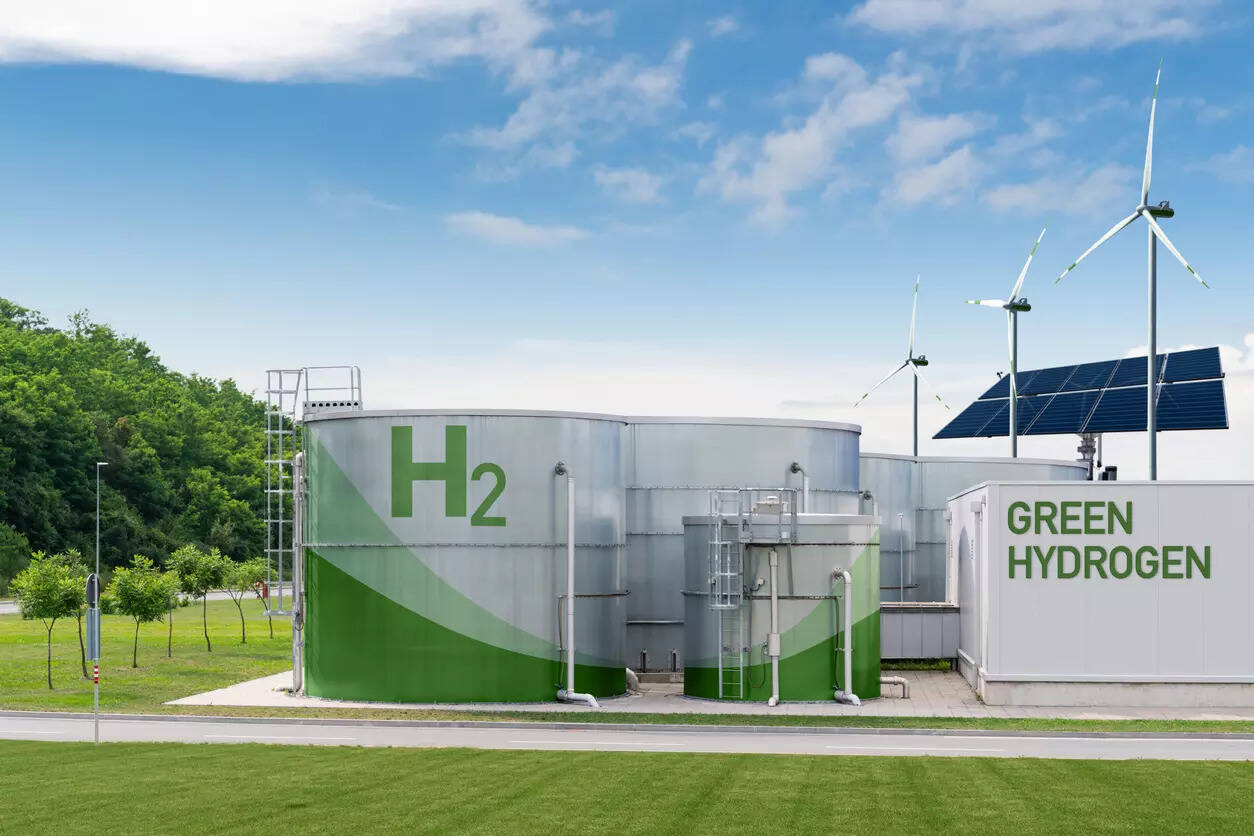
Newly launched clean energy platform LNK Energy plans to enter the green hydrogen and green ammonia segments over the next three to five years, once domestic supply chains mature and initial manufacturing assets stabilise, its co-founders told ETEnergyWorld.
“Green hydrogen and green ammonia are opportunities we are looking at three to five years from now. By then, the supply chain in India would be more stabilised. The idea would be to start with a smaller project and then scale,” said Kushagra Nandan, co-founder, LNK Energy.
The company, launched on the sidelines of the World Economic Forum in Davos by three entrepreneurs coming from diverse fields, is conceived as a fully-integrated renewable energy platform spanning manufacturing, power generation and green fuels.
Its co-founders are Paritosh Ladhani, Joint Managing Director of SLMG Beverages, the largest bottler of Coca-Cola in India; Kushagra Nandan, Co-Founder, Chairman and MD, REnergy Dynamics (RED), and Co-Founder & former MD of SunSource Energy; and Varun Karad, BioEnergy Entrepreneur and Co-Founder and CEO, RED, LNK Energy.
For green hydrogen and green ammonia, the founders said that the company is evaluating multiple technologies and closely tracking market developments. Nandan added that early-stage discussions with potential end-customers were underway, though investment decisions will follow once clarity emerges on technology choices and demand visibility.
“Green fuels will require a combination of solar generation, battery storage and integrated manufacturing. That is where an integrated platform gives us a competitive advantage,” said Varun Karad, co-founder, LNK Energy.
The founders said that solar manufacturing remains the immediate priority amid rising domestic demand across utility-scale, commercial and industrial, and residential segments.
“Today, India consumes around 55-60 GW of solar modules annually, while domestic cell capacity is only about 15 GW… Solar cell demand could rise to 80–100 GW by the end of the decade,” said Nandan.
Nandan, who is also the co-founder, chairman and managing director, REnergy Dynamics (RED) said that while concerns around potential overcapacity in solar modules persist, LNK Energy believes that gaps remain in advanced cell manufacturing and upgraded technologies.
“About 24 GW of existing module capacity is based on older technology and needs upgrading. Distribution reach and market understanding especially in challenging regions would help carve out a niche,” he added.
Managing China exposure
On supply chain risks, the company acknowledged that avoiding China-linked inputs entirely remains difficult in the current global manufacturing ecosystem. However, the founders said that it is adopting a diversified sourcing strategy, working with partners and technology providers across Germany, Taiwan, Malaysia and China.
“Once the plant is operational, we will be manufacturing locally. As we move upstream into wafers and ingots, the forex savings for the country will be significant,” said Nandan.
He added that German technology experts are already involved in the early phases of plant development, while the company is also exploring commercialisation of existing Indian research and manufacturing capabilities.
Big-ticket investment
LNK Energy plans to invest about ₹10,000 crore over the next five years. On investment strategy beyond the initial phase, Nandan said that the company would tap internal accruals and capital markets at an appropriate stage, though it said it was too early to comment on an IPO.
“The first phase entails an investment of about ₹1,200 crore, funded through a 70:30 debt-to-equity mix. The company has already secured around ₹700 crore in debt, with the balance equity tied up,” said Paritosh Ladhani, co-founder, LNK Energy.
On the solar production-linked incentive (PLI) scheme for the solar segment, the founders said that government support through schemes such as the solar PLI remains important for large-capex manufacturing businesses to remain globally competitive.
“PLI helps bring down production costs, which is critical if Indian manufacturers want to compete in global markets… State-level incentives are also increasingly complementing central support,” said Nandan.