

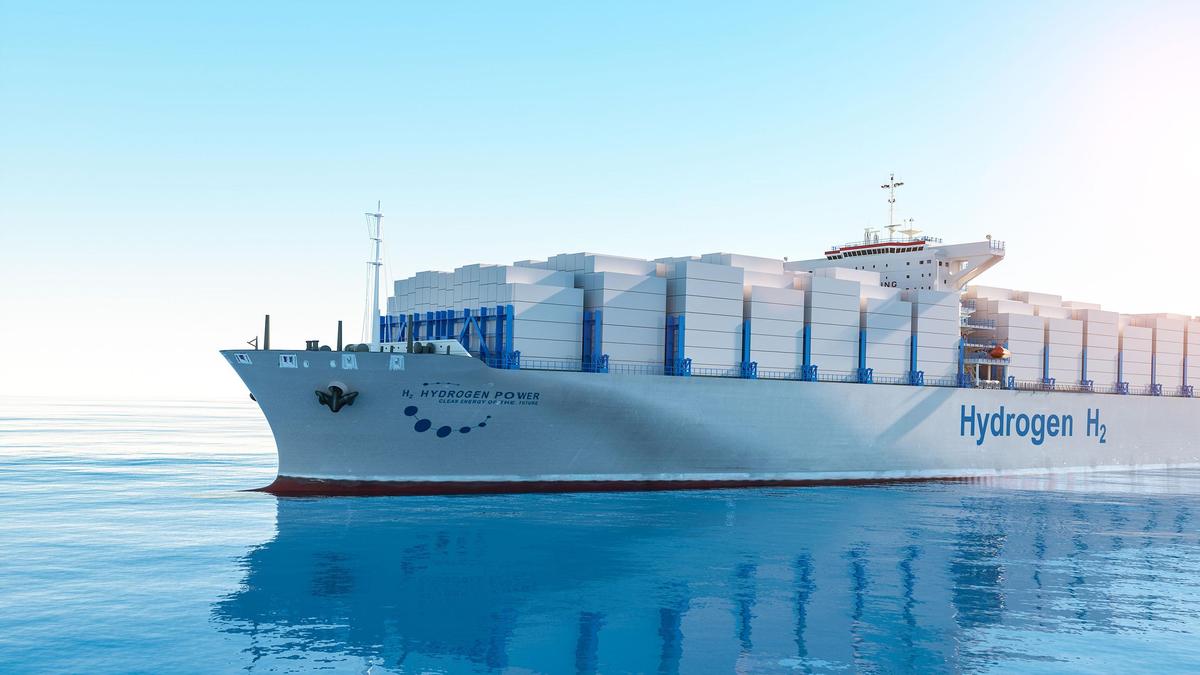
India’s green hydrogen ambition faces a stark water-energy paradox.
| Photo Credit:
audioundwerbung
It is not often that a single molecule captures the imagination of an entire nation. But hydrogen — the lightest element on Earth — is suddenly carrying the heaviest expectations of India’s clean-energy transition. In global climate conversations, it is no longer a whisper; it is a thunderous promise. As India races to unlock vast renewable capacity and industries chart their decarbonisation paths, green hydrogen is emerging as the fuel that could power factories, clean up refineries, and propel long-haul transport without carbon emissions.
At the centre of this vision is the National Green Hydrogen Mission, led by MNRE with support from key ministries, which targets five million tonnes annually by 2030, backed by hydrogen valleys, industrial parks, and electrolyser manufacturing. Confidence is high that India can meet its climate goals and shape global supply chains — yet beneath this excitement lies a quieter, more fragile reality.
India’s green hydrogen ambition faces a stark water-energy paradox. Electrolysis demands nearly nine litres of purified water per kilogram of hydrogen, far more when accounting for cooling and purification losses. Yet, India already extracts one-quarter of the world’s groundwater (more than China and the US combined), with aquifers falling by up to four metres due to subsidised farm pumping. Several States blessed with intense solar radiation — ideal for powering electrolysers — are simultaneously cursed with extreme water stress. This includes Rajasthan, Gujarat, Odisha and Tamil Nadu.
Hydrogen plants are rapidly emerging — from Kandla and Kutch to Gorakhpur, Bikaner, Mangaluru, Thoothukudi, Gopalpur and soon Andhra Pradesh, alongside inland sites in Hisar and Baddi. But geography matters: producing six million tonnes of hydrogen could demand 132–192 million tonnes of water annually, rivalling major cities’ drinking needs. Therefore, the challenge then is not whether India can produce green hydrogen. It is whether it can produce it without taxing the water on which lives and livelihoods depend.
Hydrogen without regret
The answer to this dilemma is not to slow the hydrogen mission — but to site it smarter, design it wiser, and power it circularly. Coastal hydrogen hubs can draw seawater rather than freshwater. Global footprints are turning to the ocean to fuel the hydrogen revolution — from Scotland’s EMEC, which has produced hydrogen from tidal energy and seawater since 2017. Other projects in Australia, Singapore, Norway, and France that integrate seawater electrolysis with offshore renewables. These initiatives demonstrate how coastal and marine energy systems can enable sustainable hydrogen production without depleting scarce freshwater reserves.
India should follow these footsteps, creating an innovative method to produce hydrogen from alkaline seawater using low-cost, corrosion-resistant bimetallic catalysts — a breakthrough that circumvents the chloride corrosion typically associated with saltwater electrolysis. A novel global experiment has demonstrated that replacing the traditional, high-cost metallic positive electrode with a non-metallic, low-cost alternative is feasible. This low-cost, high-performance solution could redefine the future of seawater electrolysis, with the capacity to produce green hydrogen at an industrial level. This would enable India to scale up its coastal hydrogen plants sustainably, transforming its vast shorelines into hubs of green innovation.
Scaling such coastal hydrogen systems demands evolved policy: coordinated MNRE–Jal Shakti planning, hydrological budgeting, water-use audits, and incentives for non-freshwater inputs. Ports such as Kandla, Paradip, and Thoothukudi could become hubs for green ammonia exports, while inland plants should rely on treated wastewater rather than groundwater.
India’s hydrogen story is a rare convergence of industrial ambition, climate necessity, and geopolitical opportunity. If India pulls too hard on the “hydrogen rope” without easing the “water knot,” the transition risks swapping carbon scarcity for water scarcity.
Pohit is a Professor, and Mondal is a Research Associate at the NCAER. Views are personal
Published on November 27, 2025


