

Marrakech – Morocco’s Institute for Research in Solar Energy and New Energies (IRESEN) marked its strongest showing yet at the World Power-to-X Summit, which concluded yesterday in Marrakech. The fifth edition of the annual gathering brought together policymakers, researchers, and industry partners to advance the kingdom’s green hydrogen ambitions.
IRESEN Director General Samir Rachidi told Morocco World News (MWN) that the hydrogen sector has entered a more realistic phase. “In the previous editions, we were very enthusiastic towards gigawatt scales,” Rachidi said during the summit’s opening. “Now, I think it’s more positive because now people are more realistic and more in phase with what is feasible.”
Rachidi cited recent data showing the momentum behind the technology. More than 500 hydrogen projects worldwide have reached final investment decisions, entered construction, or begun operations – representing approximately $110 billion in total investment, according to the Global Hydrogen Compass report by the Hydrogen Council.
Morocco builds capacity and expertise
IRESEN, founded in 2011 at the initiative of Morocco’s energy ministry and key public and private sector actors, funds market-oriented research and bridges universities with industry. The institute runs the Green Energy Park in Benguerir and operates competitive funding calls to accelerate the commercialization of clean energy technologies.
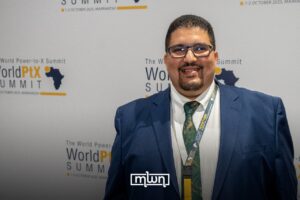
Rachidi explained Morocco’s measured approach to hydrogen development. The country took time to evaluate opportunities and maximize socioeconomic and environmental impact following King Mohammed VI’s November 2022 speech launching the Moroccan Hydrogen Offer, which was formally published in 2024.
“Now, this year, we already have many projects that are on the table that are in very advanced phases,” Rachidi said. “We heard this morning pre-feed and feed, so it’s really high-level or advanced levels in terms of project development.”
Rachidi outlined IRESEN’s coordination to build human capital with universities and strategic partners, including OCP Group and Mohammed VI Polytechnic University (UM6P).
“We are trying to prepare the ground for capacities, for human capital, for researchers to be aware of what the key thresholds and innovations are that are needed to unlock this transition to large-scale deployments,” he stated.
The institute also works to train professionals who will design, construct, operate, and maintain large-scale hydrogen facilities. “I think it’s a matter of 3-5 years, and we started three or four years ago,” Rachidi added. “I think we are getting there slowly, insha’Allah.”
International partnerships deliver research equipment and electrolysers
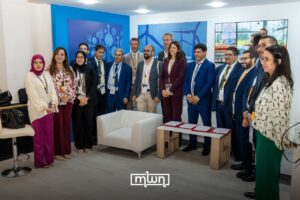
The summit witnessed multiple equipment deliveries strengthening Morocco’s hydrogen research infrastructure.
Belgium’s Cluster TWEED and Wallonie Bruxelles International delivered a laboratory electrolyser (model MDQ220L) manufactured by John Cockerill under the SEHIM2 Morocco-Wallonia cooperation program, providing IRESEN with strategic research equipment.
An official signing ceremony formalized the delivery of a 25-kW electrolyser to the École Nationale des Sciences Appliquées (ENSA) in El Jadida, part of Chouaïb Doukkali University.
The project represents structural cooperation between Morocco and Wallonia, carried by IRESEN and Cluster TWEED with support from Wallonie-Bruxelles International and contributions from John Cockerill.
The electrolyser, valued at €195,000 ($213,450), benefits from joint financing provided by Wallonie-Bruxelles International at €95,000 ($104,050) and John Cockerill at €100,000 ($109,500).
The equipment falls within the SEHIM2 program (2023-2027), which is designed to develop innovative solutions for energy storage and green hydrogen production serving Moroccan industries.
Rémy Balegamire, Project Manager at Cluster TWEED, told MWN the delivery represents a concrete Belgium-Morocco collaboration. “We are happy to be here, Cluster TWEED, Wallonie Bruxelles International, together with John Cockerill, to push for innovation in green hydrogen production,” Balegamire said.
The installation at ENSA El Jadida will strengthen research and training capacities by providing students, doctoral candidates, and researchers with cutting-edge technology for scientific experimentation and applied training.
“This will actually provide good insight to young people, young engineers who want to get into the industry,” Balegamire stated. “It will help to roll out at a bigger scale, of course, the activity of green energy production.”
In her turn, Chiraz El Fassi, General Delegate of Wallonia-Brussels in Morocco, told MWN the agreement marks a strategic milestone.
“On behalf of Wallonia and the Wallonia-Brussels delegation, I am very pleased to be here at the Power-to-X Summit in Marrakech,” El Fassi said. “Today, we are gathered for the signing of an agreement – an agreement to provide an electrolyzer from the company John Cockerill.”
El Fassi explained the institutional framework supporting the collaboration. “This entire project is being carried out under the auspices of the TWEED Cluster, the Walloon Energy Cluster, with the support of Wallonia-Brussels International,” she stated. The initiative falls within the SEHIM2 project’s broader scope of strengthening research and industrial partnerships.
Meanwhile, the water-energy nexus drives the partnership’s focus. “It is a cooperation project between Wallonia and Morocco that falls within the priorities of our bilateral partnership,” El Fassi concluded. “The theme of water and energy for sustainable development is one of the key areas of cooperation between Morocco and Wallonia.”
Czech Republic delivers water-from-air technology
Alongside the Belgian electrolyser delivery, the Czech Republic provided water-from-air technology to IRESEN through a government-to-government initiative funded by Czech Aid. Morocco became the first country to receive and benefit from this innovative solution.
Ilja Mazánek, Senior Business Development Manager at Czechoslovak Export, told MWN about the pioneering nature of the project. “We will be supplying two units of our unique technology that generates water from air to our esteemed client, IRESEN, here in Morocco,” Mazánek said.
“It’s part of a project funded by the Czech Development Agency, Czech Aid. It’s a G2G, that means government-to-government project.”
The collaboration extends beyond simple equipment delivery. “Not only will we deliver these devices here, but we will also profit from IRESEN’s expertise and from Morocco’s unique climatic conditions,” Mazánek explained.
“We will receive data about the performance of these machines, of this technology, and perhaps even have further discussions with our partners at IRESEN on how these machines can be exploited and perhaps even improved.”
Looking ahead, Mazánek outlined short and medium-term objectives. “We really hope to have the machines installed in Morocco, obtain all the data from the field, and also evaluate them as such, and profit from IRESEN’s expertise,” he said.
From a long-term perspective, Mazánek expressed strong confidence in the technology’s potential. “This very technology is patent-protected, award-winning,” he noted.
“It has been tested previously, successfully in Australia and in the Emirates in very harsh, challenging climatic conditions.” He believes the technology will validate itself in Morocco and generate additional projects as a consequence.
The water-from-air prototype reached a total value of MAD 1.6 million ($160,000), financed by CzechAid at CZK 3.9 million.
France funds collaborative projects
Beyond equipment deliveries, IRESEN announced the results of two major international funding calls during the summit. The Inno France-Morocco Tech Transfer program awarded MAD 6 million ($600,000) to three green hydrogen projects, funded by the French Development Agency (AFD).
Bertrand Poche, AFD Deputy Director in Morocco, stated his agency’s commitment to the partnership. “By encouraging collaborative innovation in green hydrogen, we are laying the groundwork for industrial solutions that will serve both our countries and contribute to the global energy transition,” Poche said in a press release shared with MWN.
“The AFD is proud to stand alongside IRESEN and all the partners in building bridges between science and industry, Morocco and France, for a more sustainable future.”
The selected French collaboration projects include GreenH2Hub, focusing on hybrid hydrogen production from biomass and electrolysis within a circular economy approach. Scientific partners include UM6P, Green Tech Institute, and École Nationale Supérieure de Chimie in Kénitra, working with industrial partner H2X.
Additionally, the DakH2A project aims to develop innovative solutions to produce e-fuels from green hydrogen and CO₂ captured from the air, optimizing capture technologies to reduce costs. IRESEN’s CO₂ & Agritech Systems Department serves as a scientific partner, working with MGH Energy and MGH Energy Morocco.
The third project, Great H2, positions itself as a strategic planning tool. It involves developing an intelligent Geographic Information System (GIS) platform to identify optimal sites for green hydrogen production, model storage and transport infrastructure, and simulate integration into the energy system.
Green Energy Park leads the scientific work, partnering with Energy Pool Développement and Energy Pool Développement Maroc.
Concluding the signing ceremony, which was also attended by France’s Ambassador to Morocco Christophe Lecourtier, Rachidi reiterated the institute’s commitment to collaborative innovation.
“Through the Inno France-Morocco Tech Transfer call for projects, we reaffirm that collaborative innovation and technology transfer are decisive levers to accelerate the energy transition,” he said. “They firmly position Morocco and France as strategic partners in the global economy of green molecules.”
Spanish collaboration supports innovation
IRESEN awarded MAD 3 million ($300,000) to two projects under the fourth InnoEspa-Morocco Energy call. The program, conducted in close partnership with Spain’s Centre for the Development of Industrial Technology (CDTI), stimulates high-level collaborative innovation and fosters academic-industrial consortia.
The E-PAVE project aims to transform roads into sources of renewable energy by integrating electrospun piezoelectric membranes directly into asphalt. Its objective involves capturing energy generated by traffic while preserving infrastructure durability and integrity.
E-PAVE combines nanotechnology with recycled materials to provide a scalable solution that is both technically and economically viable.
Scientific partners include UM6P and Hassan II University of Casablanca’s Faculty of Sciences Aïn Chock, working with industrial partner Fox Transport.
Similarly, the STDSCWG project aims to provide sustainable drinking water to arid regions or areas with limited access to freshwater using a desalination system powered by renewable energy. The system automatically adjusts its parameters to optimize efficiency and reduce waste, while remaining cost-effective and easy to deploy.
Hassan II Institute of Agronomy and Veterinary Medicine serves as a scientific partner, working with industrial partner Harmony Technology.
Regarding these initiatives, Rachidi stressed the strategic importance of bilateral cooperation. “Through the InnoEspa-Morocco Energy Call for Projects, we reaffirm that collaborative innovation and technology transfer are decisive levers to accelerate the energy transition,” Rachidi stated in another press release.
“They firmly position Morocco and Spain as strategic partners in the global economy of green molecules.”
In parallel, Spain’s Centre for the Development of Industrial Technology approved nearly €500,000 ($547,500) in complementary financing for Spanish industrial partners. This additional contribution illustrates the strong leverage effect of international cooperation mechanisms.
From pilot to pre-industrial scale
IRESEN’s hydrogen work extends beyond funding calls into operational pilot projects. Together with UM6P and OCP Group, the institute launched Green H2A at Jorf Lasfar – Africa’s first integrated hydrogen-to-ammonia pre-industrial demonstration facility.
The pilot targets approximately four tons per day of green ammonia via the Haber-Bosch process, fed by a pre-industrial hydrogen unit equipped with both PEM and alkaline electrolysers rated at 2 MW each. The facility tests operations, offtake, and fertilizer applications.
Before Jorf Lasfar, IRESEN and UM6P established a smaller system in Benguerir featuring a 20-kW electrolyser coupled with photovoltaic panels. This prototype produced hydrogen for mobility and storage use cases, reducing technology risks and training operators ahead of megawatt-scale deployment.
The 25-kW electrolyser delivered to ENSA El Jadida complements the Green H2A Platform at Jorf Lasfar. While the industrial-scale platform tests and validates production technologies at pre-industrial levels, the academic electrolyser serves research and training purposes.
Together, these initiatives structure a unique continuum ranging from fundamental research to industrial experimentation, strengthening Morocco’s position as a regional green hydrogen hub.
Summit addresses bankability and export readiness
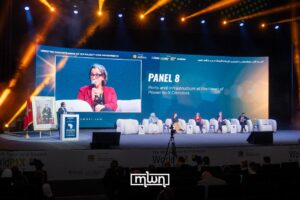
The two-day summit concentrated on project finance, risk management, and market creation. Organized by Morocco’s Ministry of Energy Transition in partnership with IRESEN, the Green H2 Cluster, UM6P, and Masen, the gathering featured sessions on securing and de-risking offtake agreements, advancing green hydrogen readiness in the southern Mediterranean, and decarbonizing transport sectors.
Morocco published its comprehensive “Morocco Offer” framework in March 2024, outlining the entire value chain from renewables and electrolysis to derivative production. The framework earmarked up to one million hectares of public land, with 300,000 hectares now in active development.
Subsequently, in March 2025, Morocco’s steering committee pre-selected five investors for six green hydrogen projects worth MAD 319 billion ($31.9 billion) across three southern regions. Land reservation contracts are being executed for projects targeting green ammonia, e-fuels, and green steel production.
IRESEN also contributes to the Moroccan Green H₂ Cluster, which connects firms ranging from SMEs to multinationals with laboratories and public agencies. The institute coordinates three dimensions – economic, relational, and territorial – to accelerate industrialization.
Read also: Morocco’s 2030 World Cup: A Green Hydrogen Game-Changer


